
Chapter 1: Why projects run late
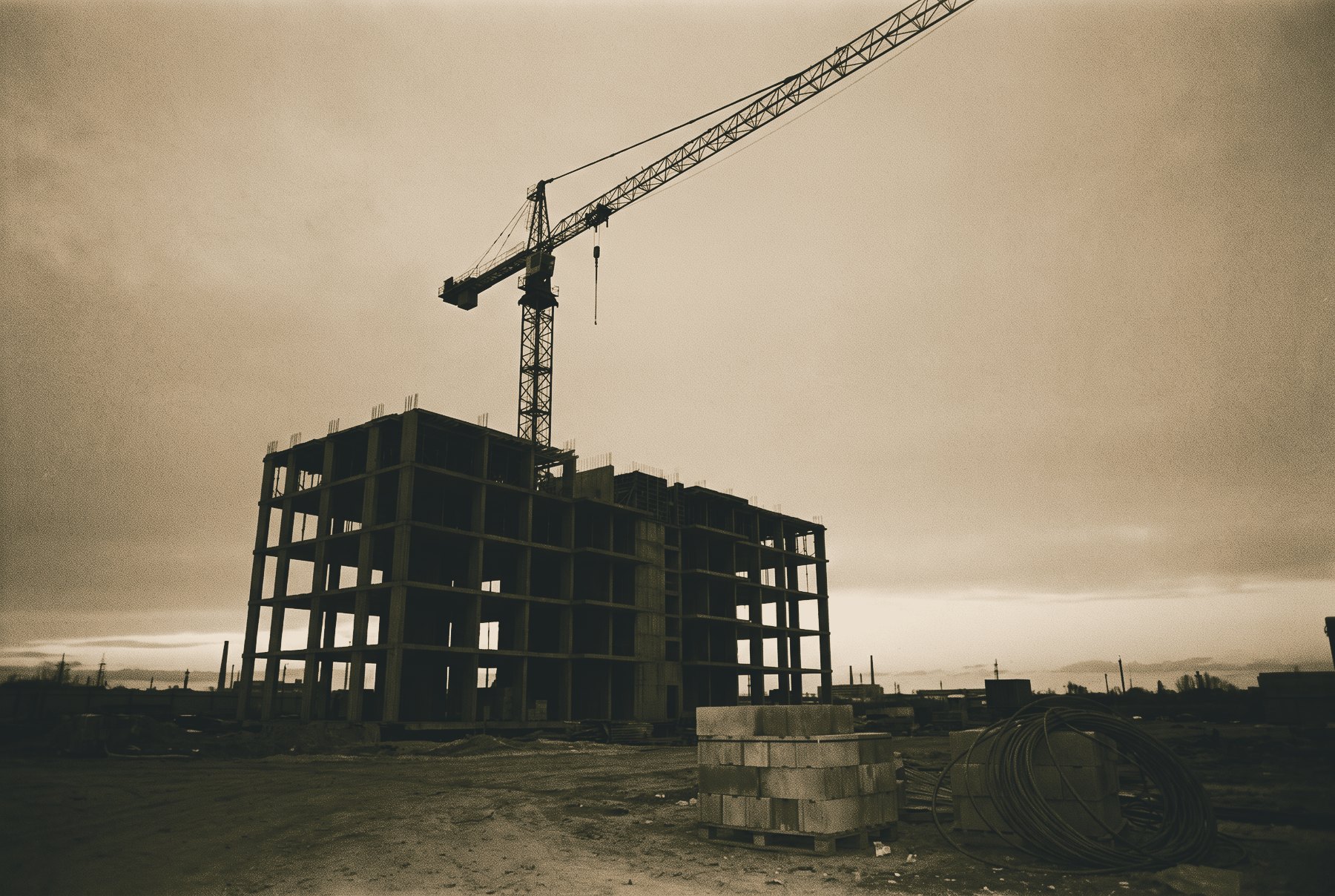
Building projects often finish late and cost more than planned. The law of delay and disruption decides who carries that time and that cost. Delay is about time: the works finishing after the date the contract sets. Disruption is about productivity: work taking more effort than it should have done. The core principle is simple. The contract allocates the risk of each thing that can go wrong, and a party gets relief only for what an event at the other side's risk actually caused. So every claim asks two questions, in order. What delayed completion, and for how long? And what is that delay worth, and who bears it?
A late job is a site problem first. It becomes a legal problem because money turns on the date. The employer may be entitled to a fixed sum for each week the works finish late. The contractor's costs of keeping the site open run for each of those weeks too. Who bears the weeks depends on what caused them and on what the contract says.
1.1 Delay and disruption
Delay concerns time. The SCL Protocol, the Society of Construction Law's guidance on the subject, says that when it refers to delay it means work activities taking longer than planned. Its focus is largely on delay to the completion of the works, which it calls critical delay (Part A para 2).
The reason is ordinary causation. A contractor's promise about time is a promise to complete the works, or a section of them, by a date: the contract completion date, moved by any extensions (SCL App A). A late activity matters in law only if it makes the works finish late. An event that holds up one activity but leaves the completion date where it was has caused no delay to completion. It gives the contractor no extension of time, and it gives the employer no damages for late finish. The Protocol calls this delay to progress: work can run late without causing the contract completion date to be missed (App A, "Delay to Progress").
Which activities matter is decided by the critical path. It is the longest sequence of activities through a project network, and the sum of their durations fixes how long the job takes. A delay to an activity on that path extends the job unless the contractor accelerates or re-sequences the work. A delay anywhere else first uses up float, the spare time an activity has before it holds up anything that follows. Chapter 2 explains both ideas properly.
The model project that runs through this guide shows the mechanism. It is invented and illustrative: a four-storey office building with thirteen activities. The contractor's programme shows it finishing in week 34, and the contract requires completion by week 36. Suppose roof design takes 8 weeks instead of 4. Roofing, M&E and fit-out all start later. Roof design had a week to spare, so the forecast finish moves by 3 weeks, from week 34 to week 37. That is one week past the contract date. The critical path has moved too: it now runs through the design activities.
Two things follow from the example. The contractor's planned finish is not the contract completion date. Contractors sometimes plan to finish early, and the Protocol keeps the two apart (App A, "contract completion date" and "Contractor's planned completion date"). And the arithmetic comes before the law. Only once the length of the delay is known can anyone ask whose risk roof design was, and who pays for the week past the contract date. Chapter 3 deals with that.
Disruption is a different thing. The Protocol defines it as a disturbance, hindrance or interruption to a Contractor's normal working methods, resulting in lower efficiency (18.1). A disruption claim is about lost productivity: the same work took more labour and plant than it should have done. So the analysis looks at productivity whether or not the work is on the critical path (Part A para 5).
The two are kept apart because they are different harms. Delay works through the date: the employer gets its building later, and the contractor stays on site longer. Disruption works through effort: more hours for the same output. A job can therefore be disrupted and still finish on time. The contractor then has no claim to an extension of time, but it may have a claim for the cost of the lost productivity (Part A para 7).
The industry often mixes the two up (Part A para 1), partly because each can cause the other. Lost productivity on a critical activity can delay completion. A squeezed programme can push the contractor into acceleration measures that lower its productivity (Part A paras 7 and 8). Where both claims are made for the same events, the second must give credit for anything recovered under the first, so that no one is paid twice (Part A para 9). Disruption is also not a cause of action on its own (18.4). The contractor needs a term of the contract, or a breach, to claim it. Chapter 11 covers disruption.
1.2 Why projects run late, and whose risk it is
Projects run late for ordinary reasons. Some come from the employer's side: design that is late or incomplete, changes to the work, late information, late access to the site. Some come from the contractor's side: too few people, slow subcontractors, defective work, a poor plan. Some come from neither: bad weather, strikes, a pandemic. Usually several run at once.

The judgments show the mix. In Walter Lilly (TCC, 2012), design work was nowhere near complete when the contractor was appointed, and the employer had very high expectations ([1]). Akenhead J said that, with hindsight, the project could be seen as a disaster waiting to happen. In Clerkenwell (TCC, 2026) the contractor put its delays down to a covid outbreak on site, transport strikes, bad weather and trouble getting materials ([13]).
What went wrong is a question of fact. Who bears it is a question of contract. A construction contract is, among other things, a bargain about risk: each side takes on some risks and prices them. The Protocol's names for the two kinds are Employer Risk Event and Contractor Risk Event. Each is an event which, under the contract, is at the risk and responsibility of that party (App A). The same event can fall on different sides under different contracts. So when a job runs late, the first document to read is the contract.
Risk allocation produces three broad outcomes. For some events the contractor gets more time and more money; events within the employer's control, such as late information, typically fall here. For some it gets time but no money. For the rest it gets neither, because the event is its own risk. The middle group surprises people. The Protocol calls it a common misconception that an extension of time automatically brings payment for the extra time (12.1).
Bad weather is the usual middle case, and the reason is a split of risk (12.2). Neither side caused the weather. The contract usually lets the contractor off damages for the time lost, so the employer bears the time risk. The contractor bears its own costs of standing still. Such events are neutral only in the sense that one party bears the time risk and the other the cost risk. Under the JCT forms the two lists are written separately. In Clerkenwell the events that gave time overlapped with, but were not the same as, the matters that gave money ([14]). Weather and strikes were on the time list only. Chapter 3 and chapter 16 sort the standard events.
Time matters because the contract usually puts a price on it. Construction contracts commonly fix liquidated damages: a sum for each day or week of late completion, agreed in advance. Parties agree them, the Supreme Court said in Triple Point, to provide a remedy that is predictable and certain ([35]). An extension of time moves the completion date. It relieves the contractor of liability for damages for delay, usually liquidated damages, for the extended period (SCL App A).
The extension clause protects the employer as well. A party should not profit from its own act. So the prevention principle says that a party cannot insist on performance it has itself prevented (Multiplex [47]). Applied to a building contract, an employer cannot hold the contractor to a completion date that the employer's own acts stopped it meeting. Without a clause that extends time for those acts, the fixed date falls away and the employer can levy no liquidated damages at all. That was the result in Peak v McKinney, as the Court of Appeal explained in North Midland [13]. An extension clause avoids it. The date moves, and liquidated damages run from the new date. The Court of Appeal said such clauses protect employers ([12]), although their primary purpose is to relieve the contractor of liquidated damages for delays that were not its responsibility ([44]).
Time means money, as the Protocol puts it. Proving delay can relieve the contractor of liquidated damages. It can also support a claim for the time-related costs of the longer job, called prolongation costs, and for steps the contractor took to accelerate (Part A para 3). Chapter 13 prices them.
1.3 Two questions, in order
Every delay claim asks two questions. The first is what delayed completion, and for how long. That is a question of fact, and in the end it is for the court to decide (Walter Lilly [377]). The second is what that delay is worth, and who bears it. That depends on the contract and on proof of cost. An employer claiming liquidated damages asks the same first question from the other side.
The order is not a formality. No one can price a delay until its length and its cause are known. The contractor's prolongation claim is measured by the period of delay that the employer's events caused, less any period in which the contractor's own delay ran alongside. The employer's liquidated damages run only for delay beyond the extended date. Both figures come out of the answer to the first question.
The money question has its own chain of proof. Akenhead J set out what a contractor claiming loss and expense must show. It needs to show, on the balance of probabilities, events which entitle it to loss and expense, delay or disruption caused by those events, and loss caused by that delay or disruption ([486(a)]). Each step is a link of causation. A break at any point ends the claim.
The two answers can differ, because the questions test different things. Suppose an employer's event and the contractor's own failing both hold up completion over the same weeks. On time, the question is whether the employer's event delayed completion. It did. The contractor gets the time because an employer cannot hold a contractor to a date that the employer's own act helped to prevent. Many of the events that give time would otherwise be acts of prevention (Walter Lilly [370]). On money, the question is whether the employer's event caused the contractor's loss. It did not, because the contractor's own failing would have kept it on site, at the same cost, anyway. In De Beers v Atos (TCC, 2010) the judge said a contractor cannot recover where it would have suffered exactly the same loss from causes at its own risk ([178]). So the contractor gets time but no money for that period.
That is the English rule for concurrent delay. In De Beers the judge put it this way: the contractor is entitled to an extension of time but cannot recover the loss caused by the delay ([177]-[178]). The judge in Thomas Barnes applied the same rule ([147]), and chapter 8 explains how firm it is.
Delay experts help the tribunal with the first question. Akenhead J described their work as in reality the same exercise the court must do: a factual analysis of what probably delayed the works ([381]). The law prescribes no method of analysis. In Thomas Barnes (TCC, 2022) the judge refused to confine an expert to one of the six methods the Protocol lists ([110]). He accepted, though, that a method that plainly does not fit, or an unexplained departure from the chosen method, can reduce the weight of the evidence ([110]). The Protocol itself is guidance. It does not take precedence over the contract or state the law (Introduction, para B). Chapter 7 covers the methods.
The party making a claim has to prove it, and the tribunal will not always rescue a claim whose analysis fails. In Tata v DBS (TCC, 2024) neither expert found the true critical path, and the court would not build its own analysis ([220]-[221]). The contractor's delay claim failed on the burden of proof ([222]). The judge tied that result to a contract that required proof of a particular date. Where no fixed date had to be proved, he said, he might have been tempted to adjust and find a middle answer ([222]). Chapter 6 takes the point further.
1.4 What getting time wrong costs
One case shows both questions at work, and what it costs to get the first one wrong. Thomas Barnes concerned a new bus station in Blackburn, shortlisted for a design award. Its construction ran over both its time and its budget, and the case was about who was responsible for that ([3]). The contract was the JCT Standard Building Contract with Quantities 2011, amended. The contract sum was about £4.46m and the period 42 weeks, from 31 March 2014 to 19 January 2015 ([50], [53]). The employer was the Council. Its consultant was designer, contract administrator and quantity surveyor at once ([51]).
Extensions granted during the job moved completion to 13 April 2015 ([54]). The Council terminated the contract on 4 June 2015 and brought in replacement contractors ([57], [217]). The contractor went into administration. Its administrators sued, funded by members of the family that owned the company ([6]). They claimed the sums due on a valuation of the work at termination, including loss and expense for prolongation, and damages for wrongful termination ([6]). By trial the claim was about £1.79m ([7], [59]). The contractor's case on time was that it was entitled to an extension to 8 November 2015 ([55]).
HHJ Stephen Davies, sitting as a High Court judge in the TCC, answered the time question first. The contractor was owed more time than the Council had given it. He fixed the extended date at 10 August 2015, an additional 119 days, but far short of the date claimed ([14], [157]). Prolongation money followed for only 27 of those 119 days. For the rest, two things were holding up completion over the same period. One was remedial work to the hub's steelwork, a problem at the Council's risk. The other was the contractor's own late roof coverings ([140], [148]). That is the time-but-not-money rule at work.
The judge called his finding on time an important starting point for the dispute about termination ([158]). On that finding, when the Council terminated, the contractor still had 9 weeks left to complete ([215]). But since the end of February 2015 the works had been held up by delays that were almost entirely the contractor's own fault ([214]). The contractor would not commit to finishing unless the Council granted an extension well beyond its true entitlement and, in effect, a blank cheque for acceleration. Meanwhile it had substantially suspended the works ([216]). The Council had not granted the full extension due and seems not to have met all its payment obligations. None of that, the judge held, excused the contractor ([216]). He upheld the termination on the contractor's conduct, before its correct completion date had even arrived ([213]-[216]).
The rest followed. The Council's costs of finishing the job would more than wipe out anything due to the contractor. So the claim had no prospect of recovering anything, and the court did not value it ([14]). The contractor was partly right: it was owed more time than it had been given. It lost everything because it stopped work to press a time claim far larger than its entitlement ([213], [216]).
Then came the costs. In court the general rule is that the loser pays the winner's legal costs: costs follow the event (CPR r.44.2(2)(a)). An arbitral tribunal applies the same principle unless it is inappropriate, subject to any agreement of the parties (Arbitration Act 1996, s.61). The contractor was insolvent, so in 2026 the court made a non-party costs order against the family who had funded the claim (Thomas Barnes (costs) [1]). The judge held that they were properly to be treated as the real parties in important respects ([42]). They are jointly and severally liable for the balance of the Council's costs as assessed, two of them only as executors of their late father's estate ([45]).
The figures in that second judgment are a lesson in proportion. The claim was first pleaded at just over £3m, a figure the company had produced itself. It was not an independent valuation ([2], [20]). The judge said it must have been obvious that the prospects on liability were no better than about evens ([20]). Two months before trial the claimant's own quantity surveyor put the claim's maximum value, on full liability, at about £1.789m; the Council's put it at about £604,000 ([22]). By then the claimant had spent about £743,000 on legal costs and disbursements ([23]). The Council's costs were about £995,000. Security covered about £583,000 of them, leaving a shortfall of at least about £412,000 on the budgeted figures ([24]-[25], [38]).
Delay litigation is expensive even for the side that wins. In Walter Lilly the parties spent between about £9m and £10m on costs, which Akenhead J called obviously disproportionate to what is in dispute ([2]). I would draw three practical points from these cases. Get an independent valuation before the big spend. Know who is funding a claim and on what terms, because a funder who controls or benefits from a claim will ordinarily pay the costs if it fails (Thomas Barnes (costs) [30]). And keep a time claim to the true entitlement.
1.5 The cast

A delay dispute has a regular cast. The guide uses one name for each role, whatever a particular contract calls it. The employer is the party under the contract who agrees to pay for the works (SCL App A). NEC calls it the Client; FIDIC calls it the Employer; other forms say Owner, Authority or Developer. The contractor carries out the works. On a subcontract the main contractor takes the employer's place and the subcontractor the contractor's, and the same analysis applies one level down (App A).
The certifier runs the contract. That includes deciding what extensions of time are due and what loss and expense is to be paid (App A, "Contract Administrator"). Depending on the contract, this is the architect, contract administrator, employer's agent, project manager or engineer. It may be one of the employer's own staff, or the employer itself, as under the JCT Design and Build form (2016 edition). The certifier wears two hats. For some purposes it is the employer's agent and carries out the employer's wishes. When it decides between the parties, its duty is to hold the balance fairly between employer and contractor (Scheldebouw [24], a case about a construction manager). It is not independent of the employer, but it must act in an independent manner ([26], [30]). Chapter 5 deals with the certifier.
The two hats can pinch. In Thomas Barnes the Council's consultant was designer, contract administrator and quantity surveyor at once. The contractor alleged that its interests as designer conflicted with its duties as contract administrator once the steelwork went wrong ([51]-[52]).
The planner prepares and updates the programme: the contractor's plan of the order and timing of the work. The Protocol wants the programme updated for progress, variations and extensions, so that it can be used as a tool for managing change and deciding extensions (Core Principle 1). It should be provided in its native electronic form, not just as a PDF, and no version should be overwritten (1.43, 1.59). Chapter 2 and chapter 14 explain why.
A delay expert analyses what delayed completion, and by how much. Each side usually instructs its own. The expert's duty is to help the court on matters within their expertise, and that duty overrides any obligation to the party paying (CPR r.35.3). A quantity surveyor measures and values work, variations and claims. On the job, quantity surveyors value the work as it goes. In a dispute each side often instructs one, as in Thomas Barnes, where both sides' quantity surveyors valued the claim (Thomas Barnes (costs) [22]).
Then there is the tribunal, in one of three forms. Adjudication is the statutory fast track for disputes under construction contracts. The adjudicator must decide within 28 days of the referral. That can be extended by up to 14 days with the referring party's consent, or longer if both parties agree (Construction Act 1996, s.108(2)(c)-(d)). The decision binds until the dispute is finally decided by a court, an arbitrator or agreement (s.108(3)). The Court of Appeal said in Carillion that in adjudication speed matters more than getting the right answer ([86]).
Arbitration is private and depends on the parties' agreement, usually in the contract. Unless the parties agree otherwise, the award is final and binding (Arbitration Act 1996, s.58(1)). In court, a building dispute can go to the Technology and Construction Court if it involves issues that are technically complex or trial by a specialist judge is desirable (CPR r.60.1(3)). Behind any of the parties there may be funders or insurers, and Thomas Barnes shows they can end up paying. Chapter 15 covers experts and tribunals.
1.6 Using this guide
The guide follows the two questions. Chapters 2 to 10 deal with time: the programme, extensions, notices, the certifier, proof, the methods, concurrency, liquidated damages and acceleration. Chapters 11 to 13 deal with money: disruption, global claims and the valuation of delay. Chapter 14 covers records and chapter 15 experts and the tribunal. Chapter 16 compares the standard forms.
Links do three jobs. A word with a dotted underline opens its glossary definition. A linked phrase about a source opens the source's own words, with the citation and a link to the full text. A case name opens the judgment itself on Find Case Law.
Most of the leading delay cases are first-instance decisions of the TCC. They do not bind other High Court judges, though they are persuasive and often followed. A Court of Appeal decision binds the courts below it; a Supreme Court decision binds every court. When Tata v DBS went to the Court of Appeal, the appeal was concerned solely with the meaning of one clause, about notices ([3]). The trial judge's findings on delay stand, but no appeal court has reviewed them.
Some points are open, and the guide says so where they arise. In 2018 the Court of Appeal noted that there was no Court of Appeal authority on whether concurrent delay gives an extension of time (North Midland [17]), and it left the point open ([50]). The TCC's decision in Mace v Baltic (2026), on reviewing an extension granted during the works, is recent, and the judge said it raised issues that were somewhat new ([43]). The guide states the law of England and Wales. In Scotland a decision-maker may apportion concurrent delay; Akenhead J held that approach inapplicable within this jurisdiction (Walter Lilly [370]). On a contract governed by another law, check that law first.
If you read one document after this guide, make it the SCL Protocol. It is guidance, and it gives way to the contract and the governing law (Introduction, para B). The four judgments I would read next are Walter Lilly, Thomas Barnes, Tata v DBS and North Midland. The live figures, starting with the programme, let you change the model project and watch what happens. Their data is invented, and each figure states its assumptions. The law is stated at September 2026. The guide explains the law; it is not advice on any particular case.
Checklist
- Read the contract first: the completion date, the events that give time, the events that give money, and the notice clauses.
- Decide whether the claim is for delay, disruption or both, and keep them apart.
- Ask whether each event hit the critical path, and from when.
- Serve notices on time, in the form the contract requires.
- Keep the programme updated in native files, and never overwrite a version.
- Keep a time claim to the true entitlement.
- Get an independent valuation before the big spend, and know who is funding the claim.
The subject in ten sentences
- Ask the two questions in order: what delayed completion and for how long, then what that delay is worth and who bears it (this chapter).
- Time and money are separate entitlements, and an extension of time does not by itself bring money (chapter 3).
- Serve every notice as if the clause were a condition precedent (chapter 4).
- Only delay on the critical path moves completion, and the path can move as the job goes on (chapter 2).
- The programme shows what was critical, and the records made at the time show what caused it (chapters 6 and 14).
- The law prescribes no method of delay analysis, and weight turns on whether the method fits and whether the expert explains it (chapter 7).
- Concurrent delay gives the contractor time but not money, unless the contract says otherwise (chapter 8).
- Disruption is lost productivity, measured where the records allow against the job's own undisrupted work (chapter 11).
- The Protocol says prolongation should be paid at the cost actually incurred, in the period when the delay was felt, unless the contract says otherwise (chapter 13).
- The tribunal decides and the experts help it, so agree the method early and serve the native files (chapter 15).