
Chapter 6: Proving delay: forecast or look back
Proving delay means showing that a particular event made the job finish later than it otherwise would have, and by how much. Three questions sit inside it. Which work was controlling the finish date when the event struck? Did the event actually hold that work up, or did something else? And from what moment is the question asked: a forecast made at the time, or a look back once the job is done? The evidence answers the first two. The contract answers the third. Throughout, the party that says the job was delayed has to prove it, and a tribunal that is not persuaded will not fill the gaps.
The three questions can pull apart even on a simple job. Take the model project used throughout this guide, which is invented and illustrative: thirteen activities, a planned finish in week 34 and a contract completion date in week 36. Roof design takes four weeks longer than planned. In week 18, when the design is finally issued, the programme forecasts completion in week 37. That is three weeks after the planned finish and one week after the contract date. The contractor then puts more labour on roofing and wins back two weeks. The job finishes in week 35, a week inside the contract date. So was the project delayed, and by how much? Standing in week 18, the answer is one week beyond the contract date. Looking back from week 35, it is none. Both answers are right, because they answer different questions.
6.1 Late activity, late project
A job's finish date is fixed by its longest chain of dependent work, the critical path. Work off that chain has float: time it can slip before it holds up anything else. A slip to non-critical work uses up float and leaves the finish date where it was. Chapter 2 explains how the critical path and float are worked out.
Only critical delay earns more time, and the reason is ordinary causation. An extension of time moves the date by which the contractor must finish, because an event at the employer's risk has made, or will make, it finish later. An event that holds up only non-critical work does not make the job finish later. It has caused nothing, so it earns nothing. The same is true of the prevention principle, which stops an employer holding the contractor to a date the employer has prevented it from meeting. Hamblen J explained that this necessarily means prevention in fact, not in theory (Adyard [264]). The SCL Protocol, the Society of Construction Law's guidance on delay, treats the point as true by definition: a delay that moves the completion date lies on the critical path (11.4(b)).
The Protocol gives the two kinds of delay names. A delay to progress holds up the contractor's work without causing a contract completion date not to be met. A delay to completion causes that date to be missed (Appendix A). Work can run late, sometimes very late, without the job finishing late.
"Late" also needs a yardstick, and there are two. The first is the contractor's own planned finish. The Protocol calls a delay to a critical activity, which pushes out the overall project duration, a "critical delay" (Appendix A, critical path). The second is the contract completion date. The Protocol notes that "delay to completion" can mean either in common usage, and it uses the phrase for delay to a contract completion date. On the model project the roof design slip moves the planned finish from week 34 to week 37: 3 weeks of critical delay. It takes the forecast past the contract date by only 1 week, because the contractor had planned to finish 2 weeks early.
Who gets the benefit of that margin is a question of float ownership, which chapter 2 covers. The Protocol's own view is that a contractor has no entitlement to more time merely because an employer's event stops it finishing earlier than the contract date, unless the contract says otherwise (8.6).
The yardstick matters because the money follows the contract date. Liquidated damages run from the completion date in the contract, and most extension clauses ask whether that date will be missed. The JCT forms show both ideas at work. Under the Design and Build Contract 2016, the contractor gives notice when progress "is being or is likely to be delayed" (cl 2.24.1). The extension then turns on whether completion is likely to be delayed thereby beyond the relevant Completion Date (cl 2.25.1.2, as quoted in Mace [44], an amended DB 2016 contract). Delay to progress triggers the notice. Delay to completion decides the extension. Chapter 4 covers the notice. The JCT 2016 forms were withdrawn on 31 March 2026 in favour of the 2024 edition, but contracts made on them are still being performed.
6.2 Critical is not the same as causing
A programme can tell you which chain of work controlled the finish date at a given time. It cannot tell you why that chain ran late, or whose risk the cause was. Those are questions of fact about what happened on site, and the answers come from the records: diaries, progress reports, correspondence, updated programmes. So a delay claim needs two separate answers. What was critical? And what made the critical work late? Winning the first does not win the second. Hamblen J put the requirement in terms of actual delay. Under the JCT form and similar contracts, the event must be at least a concurrent cause of actual delay to the progress of the works (Adyard [286]). The case was a first-instance shipbuilding dispute in the Commercial Court, but that passage summarises the English authorities on extension clauses.
Thomas Barnes shows the two questions coming apart. It concerned a bus station in Blackburn, and was decided by HHJ Stephen Davies, sitting as a High Court judge in the TCC, in 2022. The steel frame of the hub, which was the Council's risk, needed remedial work, and the contractor was also late with the roof coverings. The Council's delay expert, Mr Gunton, showed from the programme that until around 9 December 2014 there was enough float for the steelwork delay to be non-critical ([141]). On his analysis the roof coverings drove completion before that date and the steelwork after it.
The judge accepted this from a theoretical delay analysis viewpoint. But he held that it was not a sufficient answer to the point on causation ([143]). On the evidence, both items were on the critical path for the hub finishes, and both were causing delay over the same period ([140]).
The point cut both ways. The contractor could not simply say that, because the steelwork problem ran from October 2014 to January 2015, all the delay between those dates was caused by it ([144]). A cause has to be shown to have done the delaying, not merely to have existed at the time. Chapter 8 explains what that concurrent delay meant for time and money.
The same reasoning rules out blaming the last event. On a troubled job it is tempting to take the last of several delaying events and treat it as the cause of the whole overrun. But the last event may have landed on a job that was already late for other reasons, so its effect has to be measured from where the job stood when it struck. Akenhead J said as much in Walter Lilly (TCC, 2012). You cannot identify the last of a number of events and say it caused the overall delay; you must consider what critically delayed the works as they went along ([365]). A tribunal, "let alone a delay expert", has to get a handle on what was delaying the project as it went along ([392]).
The Protocol recognises the two questions in the way it groups methods. Its cause and effect methods start with an event and model its effect. Its effect and cause methods start with identifying critical delay and then look for its cause (11.4(a)). After completion the Protocol regards the second kind as generally more reliable, because it considers all the potential causes of the delay (11.4(a)). That is guidance, not law. Chapter 7 describes the methods themselves.
In practice
Keep the two questions apart in the report. Ask the expert to show first where the critical path ran and when it moved, without reference to anyone's case. Then ask for the causes of each critical delay, taken from the records and the pleaded events. A report that reads causation off the programme alone invites the answer the judge gave in Thomas Barnes.
6.3 Forecast or look back
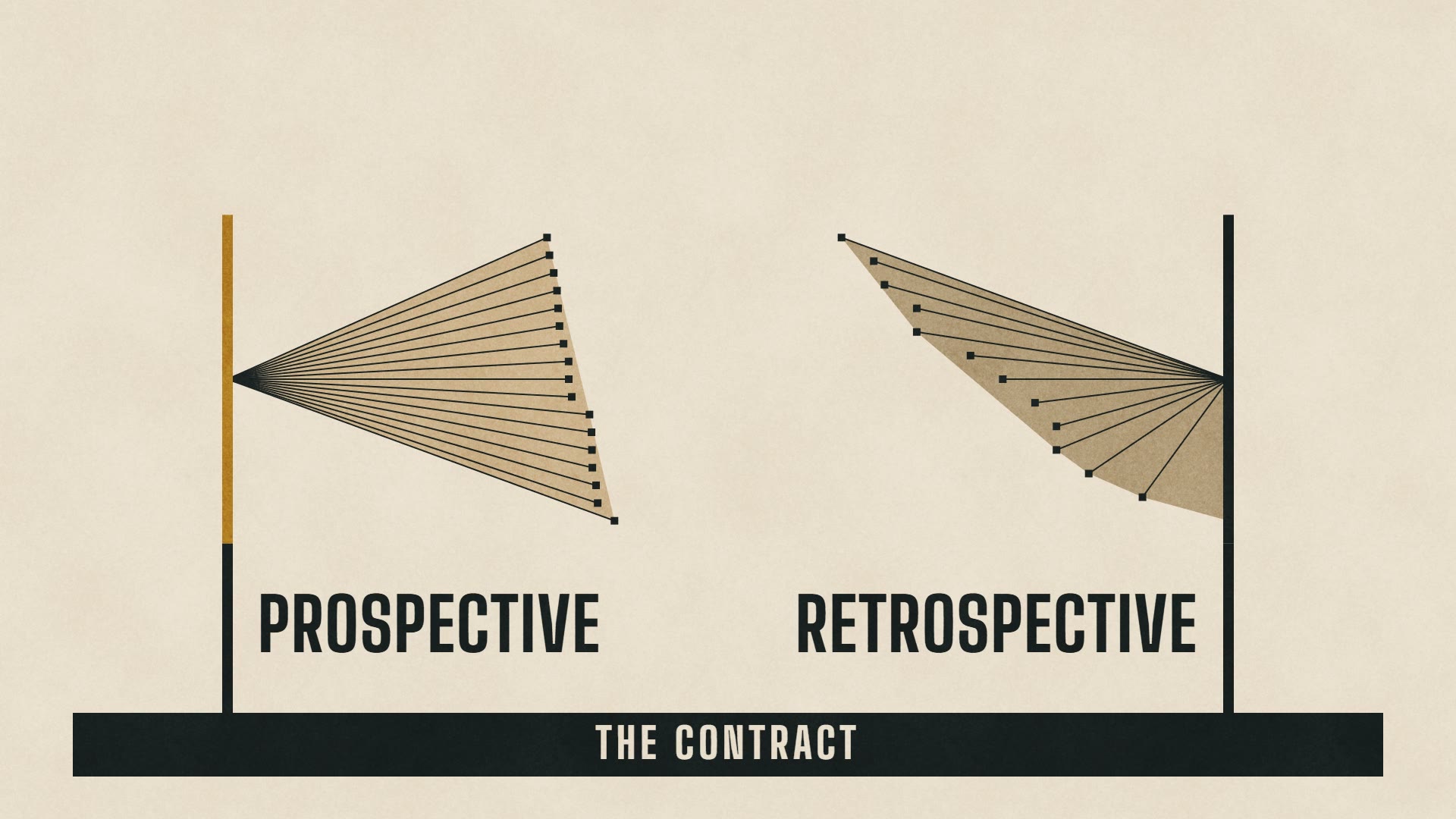
Every delay question is asked from a point in time. A prospective analysis looks forward from the event and asks what its likely effect on completion will be, on the information available then. A retrospective analysis looks back after the event, or after the job, and asks what its actual effect was. In the Protocol's words, the first identifies the likely impact of historical progress or delay events on a completion date. The second identifies their actual impact on the as-built critical path (11.4(e)). The Protocol also treats finding the critical path and measuring the delay as separate steps, and a method can take each on a different basis (11.4(d), (f)). A time impact analysis, for example, finds the path as the works proceed and measures the delay as a forecast. Chapter 7 sets out which method does what.
The two answers differ because people react to delay. Once an event is known, the contractor may add labour, change the order of work or move gangs from one area to another. Other events come along. Some risks never happen. A forecast cannot know any of that. The Protocol says a prospective analysis may not match the as-built programme, because the contractor's actual performance may have been shaped by acceleration, re-sequencing or redeployment (11.4(e)). The model project shows exactly that.
Neither answer is wrong. They answer different questions, and the Protocol accepts that prospective time for an extension and retrospective time for compensation may produce different results. That is only to be expected, and it does not necessarily mean either method is in error (12.3).
Sir Antony Edwards-Stuart said much the same in Fluor v Zhenhua (TCC, 2018). A prospective analysis does not necessarily give the same answer as a retrospective one. It is the right approach for an extension of time, but a court assessing damages needs some form of retrospective analysis ([275]). The case was a damages claim between a contractor and its supplier, not an extension of time case. So its remark about extensions is a comment rather than a decision.
Walter Lilly is sometimes cited for the opposite view. There, both delay experts accepted that each approach, done correctly, should produce the same result, and the judge called the debate sterile ([380]). That was the experts' concession on the facts of that case, not a ruling. The project had no contemporaneous critical path programme from February 2007. The judge thought that, with a sound one, the experts would probably have done the prospective exercise "in the light of the events which happened" ([380]). My reading is that the two approaches agree when nothing happens after the event to change its effect. They part company when someone accelerates or re-sequences, or a fresh event strikes. Where the contract's frame allows it, checking a forecast against what happened is sensible. Akenhead J saw nothing wrong with such a "reality check" ([378]).
Why would anyone ask for a forecast when the facts can be known? Because the contract needs decisions during the job. The contractor has to know what date it is working to, and the employer has to plan around it. Akenhead J explained that the JCT interim exercise is prospective, which makes sense so that the parties and the Architect can plan for the rest of the job (Walter Lilly [125(c)]). The Protocol takes the same line. It discourages a "wait and see" approach, and recommends granting the then predictable effect of an event and reviewing it as the impact unfolds (Core Principles 4 and 7). Once the works are complete, or long after the event, it accepts that a prospective analysis may no longer be appropriate (Core Principle 11). The frame follows the moment at which the decision is made.
 Play
Play6.4 Which question does your contract ask?
Which frame applies is a question of contract, not of programming. An extension of time is a right the contract gives, so it is measured in the way the clause asks the decision-maker to measure it, at the time the clause says. Settle the frame first. The method comes second. The Protocol itself must be considered against (and give way to) the contract and governing law (Introduction, para B).
The JCT forms
The JCT interim decision is a forecast. Under DB 2016 the employer extends time if completion is likely to be delayed beyond the completion date. It fixes the later date as he then estimates to be fair and reasonable (cl 2.25.1). "Likely" and "then estimates" are the words of a forecast. In Mace v Baltic (TCC, 2026) the judge accepted that the clause 2.25.1 exercise is prospective ([45], [47]). Akenhead J had said the same of the JCT 1998 form in Walter Lilly [125(c)].
The final review is a look back. Within 12 weeks after practical completion, the certifier must review the completion date. Under the 1998 form, Akenhead J said this will necessarily be a retrospective exercise because all the delays will have happened (Walter Lilly [125(e)]). The review is mandatory, and it applies whether or not notices were given ([125]). Looking back does not license the last-event approach. Under DB 2016 the review can fix an earlier date only to reflect instructions omitting work (cl 2.25.5.2).
A court or arbitrator deciding entitlement after the event also looks back. In Walter Lilly, Akenhead J said that a court or arbitrator has the advantage when reviewing what extensions were due of knowing what actually happened. It must decide on the balance of probabilities what delay the Relevant Events actually caused, by analogy with the final review ([362]).
An adjudicator reviewing an interim extension is in a different position. In Mace v Baltic the employer's agent had granted extensions totalling 7 weeks and 5 days ([3]). An adjudicator later reviewed the extension in the light of his own findings and reduced it to zero ([4]). Adrian Williamson KC, sitting as a deputy High Court judge, held that the adjudicator could open up the extension. But he had to perform the task the clause required: a prospective assessment in response to the notice and particulars ([50]). He had to travel back to the time at which the notice and particulars were submitted and ignore what had happened since ([51]).
The reasoning follows from the contract. The clause asked a forecasting question. An adjudicator who answers it with hindsight answers a different question and substitutes a different decision. The frame matters for a second reason. As counsel submitted and the judge accepted, under DB 2016 the employer is fixed with an interim extension, even at the final review, unless work has been omitted ([45], [47]). An adjudicator who could cut an interim extension with hindsight would undo that protection by another route. Chapter 5 covers who can reopen the certifier's decisions. The judge described the issues as "somewhat novel" ([43]). Mace is a single first-instance decision, and no later judgment had cited it by September 2026, the date at which this guide states the law.
Open question
How Mace fits with Walter Lilly [362] is not settled. The judgment in Walter Lilly speaks generally of a court or arbitrator reviewing extensions with the benefit of hindsight. The judgment in Mace says a reviewer of an interim JCT extension must ignore later events. The practitioners' text Keating on Construction Contracts, quoted in Mace, says it would be artificial to ignore entirely what in fact happened (12th edn, 8-039, as quoted at [46]). My reading is that the frame follows the decision under review. An interim grant is reviewed as a forecast made at the date of the notice. The final review, or entitlement decided after completion, looks back at what critically delayed the works as they went along. No court has put it in those terms. The judge in Mace treated the practical difficulties as points of evidence and procedure for the adjudicator ([51]).
NEC, FIDIC and bespoke clauses
NEC4 asks for both at once, split at a date. The change to the Prices for a compensation event is assessed on the actual Defined Cost of work done by the dividing date and the forecast Defined Cost of work not yet done (cl 63.1). The dividing date is usually the date of the instruction or of the notification of the event. Delay to the Completion Date is measured by how far planned Completion moves on the Accepted Programme current at the dividing date (cl 63.5). Once implemented, an assessment is not revised except as the contract provides (cl 66.3). So NEC stands on the dividing date and looks back at what has been done and forward at what has not. A forecast that later proves wrong is not, in general, corrected. Chapter 16 compares the forms in detail.
The system depends on assessing events when they happen. In NIHE v Healthy Buildings (High Court of Northern Ireland, 2017) the consultant's "forecast" came so late that it was in reality a claim for work already done by the time of the quotation ([50]). Deeny J held that the actual cost and time were relevant, and ordered their disclosure ([54], [59]). He relied on Lord Macnaghten's question from a 1903 case: Why should he guess when he can calculate? ([52]). Bwllfa was about statutory compensation, not damages ([53]). The decision is Northern Irish and only persuasive in England. It concerned the NEC3 Professional Services Contract, and there was no issue of delay in it ([19]). Its lesson is practical. Notify and assess on time, or the contract's forecast may give way to the facts.
FIDIC's wording looks both ways. The 1999 forms give time where completion "is or will be delayed". Akenhead J read those words in Obrascon (TCC, 2014), on an amended 1999 Yellow Book, when deciding when a claim could be made. The claim could be made either when it is clear that there will be delay (a prospective delay) or when the delay has been at least started to be incurred ([312]). The 2017 Red Book keeps the words "is or will be delayed" (Sub-Clause 8.5). On a later review the Engineer may increase the total extension but not decrease it (8.5).
A bespoke clause can demand a look back. In Tata v DBS (TCC, 2024) clause 7 gave the contractor, TCS, relief if it would have achieved a milestone on time but for a cause the contract put at DBS's risk. Constable J held that clause 7 requires a backward-looking analysis that identifies the actual reasons the milestone was missed ([199]). TCS's expert had tracked the forecast go-live dates in the contemporaneous plans as a proxy for actual critical delay ([171]). He never checked whether a forecast delay became actual critical delay ([172]). The judge held that his first analysis did not adopt a recognisable and logical method for the question the clause asked ([199]).
That was a failure of frame, not of software. A method is only a tool for answering the contract's question, so what matters is whether it fits that question and is explained. Tribunals do not police loyalty to a named method. In Thomas Barnes the judge held it wrong to treat the Protocol's six methods as a menu where any departure makes the expert's opinion fundamentally unreliable ([110]). But a method manifestly inappropriate for the particular case, or an unexplained departure from the stated method, can reduce the weight given to the evidence ([110]). Chapter 7 takes that further. I think the commonest way to be manifestly inappropriate is to answer the wrong question.
None of this rests on appellate authority. The English cases on the frame are all first-instance decisions: Walter Lilly, Thomas Barnes, Fluor, Tata and Mace. The Court of Appeal in DBS v Tata decided only a point on clause 6.1 ([3]).
In practice
Instruct the frame, not just the method. "Assess the likely delay as at the date of the notice, disregarding later events" and "assess the delay actually caused" are different instructions. They can give different answers on the same facts. Name the decision under review (an interim grant, a final review, an adjudicator's review, a claim for damages) and put the frame in the expert's letter of instruction.
6.5 Who has to prove it?
The cases put the burden on the party asserting the point. A contractor that says an employer's event delayed completion must prove that (Obrascon [272]). An employer that says a notice was late must prove that ([313]). This is the burden of proof. The standard is the balance of probabilities: the tribunal must think the fact more likely than not. The burden exists because a tribunal must decide even when the evidence is incomplete, and the burden tells it who loses when the evidence runs out. The House of Lords said in Rhesa Shipping that a judge is not always bound to find one way or the other. He has the third alternative of saying that the party with the burden has failed to discharge it (as quoted in Citylink [64]).
The delay cases put it strictly. In Obrascon, Akenhead J said the onus was on the contractor to prove that it was delayed by the matters now relied upon by it as critically causing it delay ([272]). For loss and expense, Walter Lilly says the contractor must prove three things on the balance of probabilities ([486(a)]). The events happened. They caused delay or disruption. And the delay or disruption caused its loss. Akenhead J added, of global claims, that the burden does not transfer to the defending party ([486(d)]). Chapter 12 deals with global claims.

An expert's view is evidence. The dispute is decided by the tribunal, so the findings of fact are its own. In Walter Lilly Akenhead J said it must be for the Court to decide as a matter of fact what delayed the Works and for how long ([377]). Both experts had in reality been doing the factual exercise that the court itself must do ([381]).
The tribunal may prefer one expert even after accepting criticisms of him. In Thomas Barnes, Mr Gunton was criticised for using a time slice windows analysis, said to suit a forecast better than a look back ([108]). The judge found some force in these complaints. He still found Mr Gunton's evidence, overall, the more convincing of the two ([46]).
Sometimes the tribunal believes neither. Tata v DBS is the clearest example. Neither of TCS's expert's two analyses was a reliable basis for concluding that the critical path ran where he said it did ([212]). Neither expert identified the true critical path ([221]). The material gave the court no reliable basis for carrying out its own as-planned versus as-built exercise ([220]). So TCS has simply not discharged the burden of proving the date by which it would have achieved the milestone ([222]). Its claim for relief failed. The appeal was about clause 6.1 only, so the delay findings stand (DBS v Tata [3]).
Constable J marked the limit of that result. Had TCS's entitlement not depended on proving a milestone date, the court might have been tempted to adjust the experts' work to reach a middle-ground answer ([222]). So a tribunal is free not to choose between the experts, and it can reason from the facts to its own answer. That freedom is not a promise to rescue an unproved claim. Where the contract makes the claimant prove a date, only an analysis that survives will prove it.
The tribunal will not rescue a claim for reasons of fairness as well as the burden. A tribunal may reach findings neither side put forward, but it should not build a case one side never made and the other never had the chance to answer. The Protocol makes the same point in its guidance on global claims (17.4). Where the contractor has failed to identify the events and quantify their effect, it is not the responsibility of the CA, adjudicator, judge or arbitrator to do so.
Adjudicators are held to the same line. In Balfour Beatty v Lambeth (TCC, 2002) the adjudicator built his own as-built programme and critical path without telling the parties his method. HHJ Humphrey Lloyd QC held that an adjudicator may not make good fundamental deficiencies in one party's material without giving the other a proper chance to respond ([33]). Chapter 15 covers the procedure.
A formal critical path analysis helps, but its absence is not always fatal. The Scottish Inner House said in City Inn that a sound analysis may be of assistance, but a claim without one does not necessarily fail ([42]). That is persuasive in England, not binding. The Protocol agrees that the critical path may sometimes be found more reliably from a practical analysis of the facts than from software (11.4(c)). What cannot be missing is proof, from the records, of what happened and why. Chapter 14 is about those records.
Checklist
- Read the extension clause before the programme. Name the decision under review and the frame it asks for.
- Put that frame in writing in the expert's instructions.
- Measure against the right date: the planned finish or the contract completion date.
- Show criticality first, then prove causation from the records.
- Do not blame the last event for the whole overrun.
- Use hindsight as a check where the frame allows it, and explain any departure from the stated method.
- Under NEC, notify and assess each event on time.
- If the contract makes you prove a date, prove one. Do not expect the tribunal to build it.
Chapter 7 explains the six methods experts use to answer these questions. Chapter 8 covers two causes competing for the same delay, and chapter 14 the records that prove what happened.