
Chapter 11: Disruption and lost productivity

Disruption is what happens when work takes more hours than it should, because something got in the way of the contractor's planned way of working. The SCL Protocol calls it a disturbance, hindrance or interruption to the contractor's normal working methods that lowers its efficiency. Delay is about dates. Disruption is about productivity: how much work a gang gets done for each hour it is paid for. The core principle is the ordinary one for any money claim. The contractor recovers the cost of lost productivity only if the contract or the law makes the employer answerable for the cause, and only for the hours that cause actually cost. So it must prove an event at the employer's risk, a loss of productivity caused by that event, and the cost of that loss.
The last step is where most of the argument lies. Nobody records the hours the work would have taken if the event had never happened. They have to be estimated from something. The tender is the obvious yardstick, but it may have been optimistic, and the employer is not answerable for the contractor's pricing. The better yardstick is the job itself: a stretch of the same work, on the same site, that the events did not touch. That comparison is called the measured mile, and most of this chapter is about doing it properly.
Take the model project that runs through this guide. It is invented and illustrative: a four-storey office with thirteen activities, planned to finish in week 34 against a contract completion date of week 36. Cladding is planned for 8 weeks, from week 15 to week 23, with 4 weeks of float. Suppose the cladding drawings arrive piecemeal and the cladders end up sharing floors with the M&E trade. The gang finishes in week 26 instead of week 23. That is inside its float, so completion does not move and no extension of time is due. But the gang has booked, say, a third more hours than the work should have taken. Those hours cost money. If the late drawings were the employer's responsibility, that money may be recoverable.
11.1 Hours, not dates
Two words need separating first. Production is output: panels fixed in a week. Productivity is output for each hour of input: panels fixed per labour hour. A gang can keep up its production and still lose productivity, simply by putting in more hours. The North American cost-engineering body AACE International gives the example of a pipe crew laying its planned 300 feet a day while using twice the planned labour. The crew is accomplishing 100% of planned production but operating at 50% productivity. The programme shows nothing wrong. The wage bill does.
Delay and disruption are different effects, and the SCL Protocol warns that the industry often associates or conflates them. They come apart because of the critical path. Completion moves only when the delayed work is on the critical path, or has used up its float (chapter 2). Productivity can fall on any activity, critical or not. So a disruption analysis looks at the productivity of the work whether or not that work is critical (SCL Part A para 5).
That is why disruption can happen without any delay to completion. The Protocol puts it directly: work can be disrupted and yet for the works still to be completed by the contract completion date. The contractor then has no claim for an extension of time, but it may have a claim for the cost of the lost productivity.
The reason is that time and money answer different questions. An extension of time protects the contractor from liquidated damages for finishing late. If nothing finished late, there is nothing to protect it from. Money asks a different question: did the employer's event cause the contractor a cost? A gang that burns a third more hours has incurred a cost, whatever the completion date. The Protocol's core principle 12 makes the same point from the other side: entitlement to an extension of time does not automatically carry money, and money does not automatically carry time.
The reverse also happens. A job can finish late while every gang works at its normal rate. If the employer suspends the works, nobody is working, so nobody is working slowly. The contractor's costs are time-related: site overheads and plant kept for longer (chapter 13). Even then the line is rarely clean. When crews are laid off and brought back, they may have to go through another learning curve.
More often each causes the other. Work done at lower productivity leads to activity delay, or to acceleration to avoid it, or to both (SCL Part A para 5). Delay can cause disruption, too: a contractor with less time may accelerate, and the accelerated work may be done at lower productivity (SCL Part A para 8). AACE goes further: there is very little loss of productivity that does not involve some element of delay followed by attempted or actual acceleration somewhere in its chain of causation. Where the disrupted work is critical, disruption can turn into delay to completion, and the contractor can run a delay analysis alongside the disruption analysis (SCL 18.29).
Where both claims are made, the money can overlap. A week of extra supervision might be claimed once as prolongation, a cost of the longer job and again as a cost of the less productive gang. The same cost cannot be recovered twice, so the Protocol says a credit has to be given in the second claim for anything recovered in the first. Chapter 13 deals with how that is done.
11.2 What slows a gang
A contractor prices a job on a plan: a gang of a certain size, a run of work in a certain order, a certain number of hours. Disruption is anything that stops the gang following that plan. The Protocol gives the direct causes: piecemeal site access different from that planned, out of sequence works or design changes. Each breaks the run. A gang sized for a continuous run of work waits, moves, starts again somewhere else, and comes back.
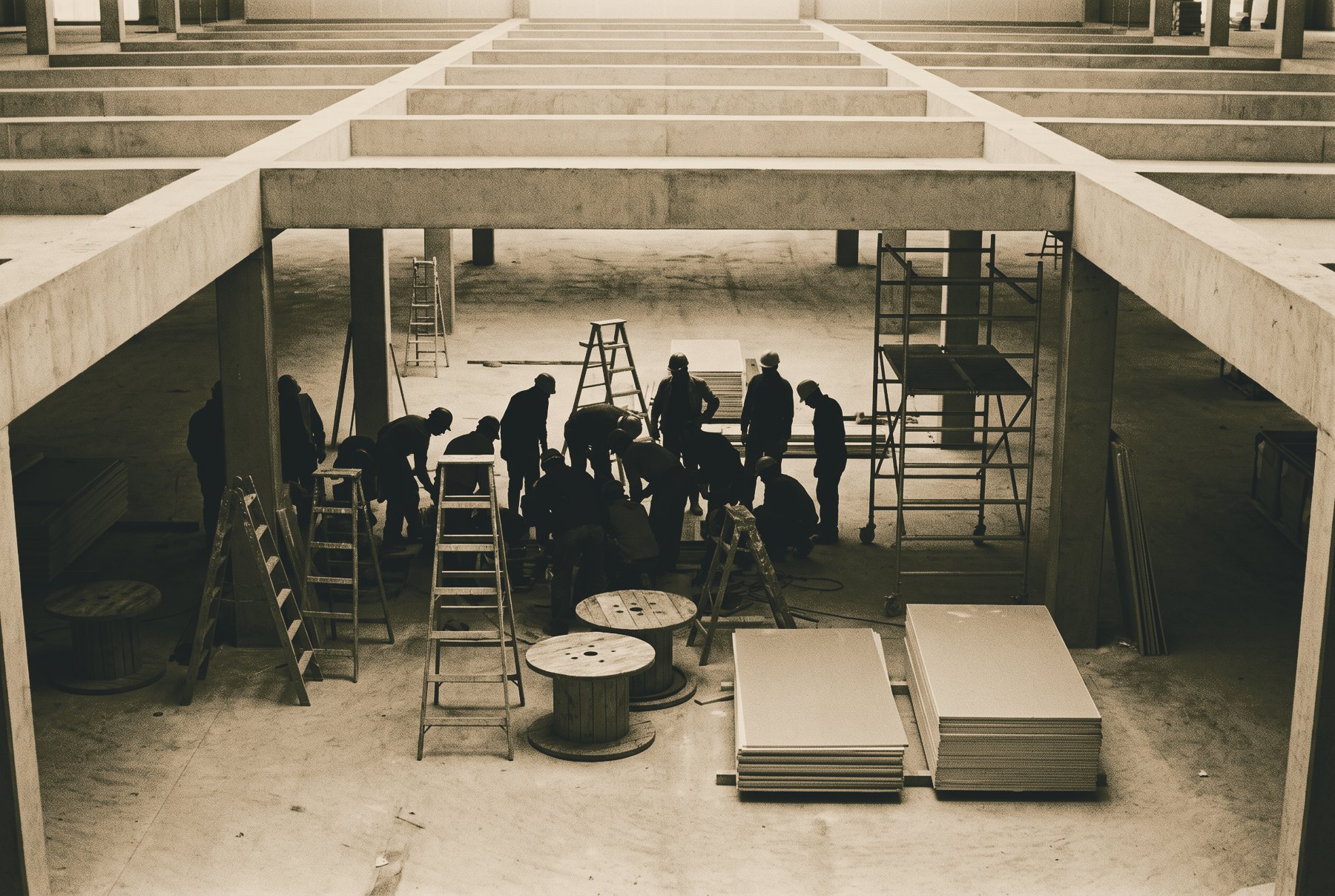
Those direct effects produce knock-on effects, and the knock-on effects are usually where the hours go. The Protocol lists crowding of labour or stacking of trades, dilution of supervision through fragmented work gangs, excessive overtime, repeated learning cycles and poor morale. Stacking of trades is the easiest to picture. Every worker needs room, a clear route for materials and access to the face. Put three trades into one bay and each waits for the others: ladders move, deliveries queue, a finished section gets damaged and redone. Split a gang to cover several fronts and one supervisor ends up watching three places at once.
Acceleration can cause the same problem. A contractor that adds people to catch up may crowd the work. The Protocol notes that any resulting crowding of labour may lead to loss of productivity, which can found a disruption claim of its own. Chapter 10 deals with acceleration itself.
Changes are the commonest cause. A variation adds work, but it also disturbs the work around it. AACE describes disruption as the effect of change on unchanged work, which shows up mainly as lost labour productivity. That is why pricing a variation as a list of extra items often understates its cost. The practical answer is to price the knock-on effect when the variation is agreed. The Protocol says it is not good practice to leave the disruption element of several variations to be compensated separately at the end of the contract (SCL 19.6). Where the lost hours can be tied to a definite piece of extra work, AACE suggests claiming them as extra work instead (AACE 25R-03 s.C.2). Extra work is easier to prove than lost productivity.
In practice
Price the disruption with the variation. When you agree a variation, ask what it will do to the work around it, and put a number on that at the same time. A disruption claim assembled at the end of the job, across many variations, is harder to prove and easier to attack.
Not every slowdown is the employer's. Gangs also lose hours to poor supervision or planning, to reworking their own defects, to poorly coordinated subcontractors and to an optimistic tender (SCL 18.6). Those are the contractor's risk. It priced its own performance, and it carries the cost when that performance falls short. So the productivity loss caused by all other events must be excluded from the claim. Every method in this chapter has to deal with that step, and most disputes about disruption are really disputes about it.
11.3 There is no clause called "disruption"
Lost productivity is a cost like any other. One party can make another pay a cost only if the contract allocates that risk to the other party, or the other party broke the contract and caused the cost. Disruption is a description of what happened on site, not a legal right. The Protocol says so: disruption is also not a cause of action at law in its own right. Compensation is recoverable only so far as the contract permits or there is a cause of action (SCL core principle 18). The claim document must state which one it relies on (SCL 18.4).
The Protocol notes that most standard forms do not mention disruption by name, though they cover the events that cause it, such as unforeseen ground conditions and late instructions (SCL 18.4). In practice the money comes through one of four routes: the valuation of a variation, a loss and expense clause, a compensation event, or damages for breach. Under JCT Design and Build 2016, for example, loss and expense is payable where regular progress has been or is likely to be materially affected by a Relevant Matter. The contractor must also give the notices the clause requires. That test looks at progress, not the completion date. Chapter 16 compares the forms and chapter 13 the routes.
Whatever the route, the contractor has to prove the same three things. Akenhead J listed them in Walter Lilly, a 2012 decision of the Technology and Construction Court (TCC). First, events occurred which entitle it to loss and expense. Second, those events caused delay or disruption. Third, the delay or disruption caused it loss. The same elements apply to a claim for damages ([486(a)]), and there is no set way of proving them ([486(c)]). The burden stays with the contractor throughout (SCL 18.8), because the claimant proves its claim.
Proving disruption does not prove loss. The point came up recently outside construction, in a County Court case about an investment platform whose failures took up a financial adviser's staff time. The judge held that the fact that breaches caused disruption is not the same as proving that the disruption caused recoverable financial loss (Lumley Baxter [116]). A County Court decision binds no one and this one is not a building case, but it states the logic plainly. The claimant proved breach and disruption, failed to prove loss, and was awarded £1 in nominal damages ([296]).
A word on the Protocol, which this chapter cites often. It is guidance from the Society of Construction Law, not a statement of the law, and it gives way to the contract. I rely on it here because it is the fullest published account of the methods. Where it recommends something, treat that as good practice, not a rule.
11.4 Measuring the loss
The measure follows from the purpose. Compensation puts the contractor where it would have been if the event had not happened. So the loss is the difference between the productivity the contractor would realistically have achieved without the events and the productivity it actually achieved. The Protocol calls the first figure realistic and achievable productivity, and every method is a way of estimating it.
The Protocol divides the methods into two families (SCL 18.12). Productivity-based methods measure the lost productivity and then price it. Cost-based methods compare actual cost with planned cost without measuring productivity at all. The Protocol prefers the productivity-based methods, and this chapter concentrates on two of them.
The first is earned value. It takes the amount of man-hours reasonably included in the tender allowance for the work done and compares it with the hours actually spent. The Protocol's example is a concrete pour. The tender allowed 20 man-hours for 10 m³; the contractor spent 35. Once flawed tender assumptions and the contractor's own problems are excluded, the extra 15 hours are the productivity loss (SCL 18.16(b)).
Its weakness is the tender. The comparison assumes the tender allowance was achievable, and it may not have been. If the tender was optimistic, some of the extra hours would have been spent anyway, and the employer did not cause them. That is why the Protocol's example takes flawed tender assumptions out first. It also says original tender assumptions should not automatically be considered as a 'realistic and achievable' baseline. For the same reason it does not recommend adding unsupported percentages to tender productivity (SCL 18.8). A contractor that relies on its tender has to prove the tender was realistic. In Walter Lilly the contractor did that for its preliminaries, with evidence that the prices had been reviewed at tender stage ([492]), though that was a different kind of claim.
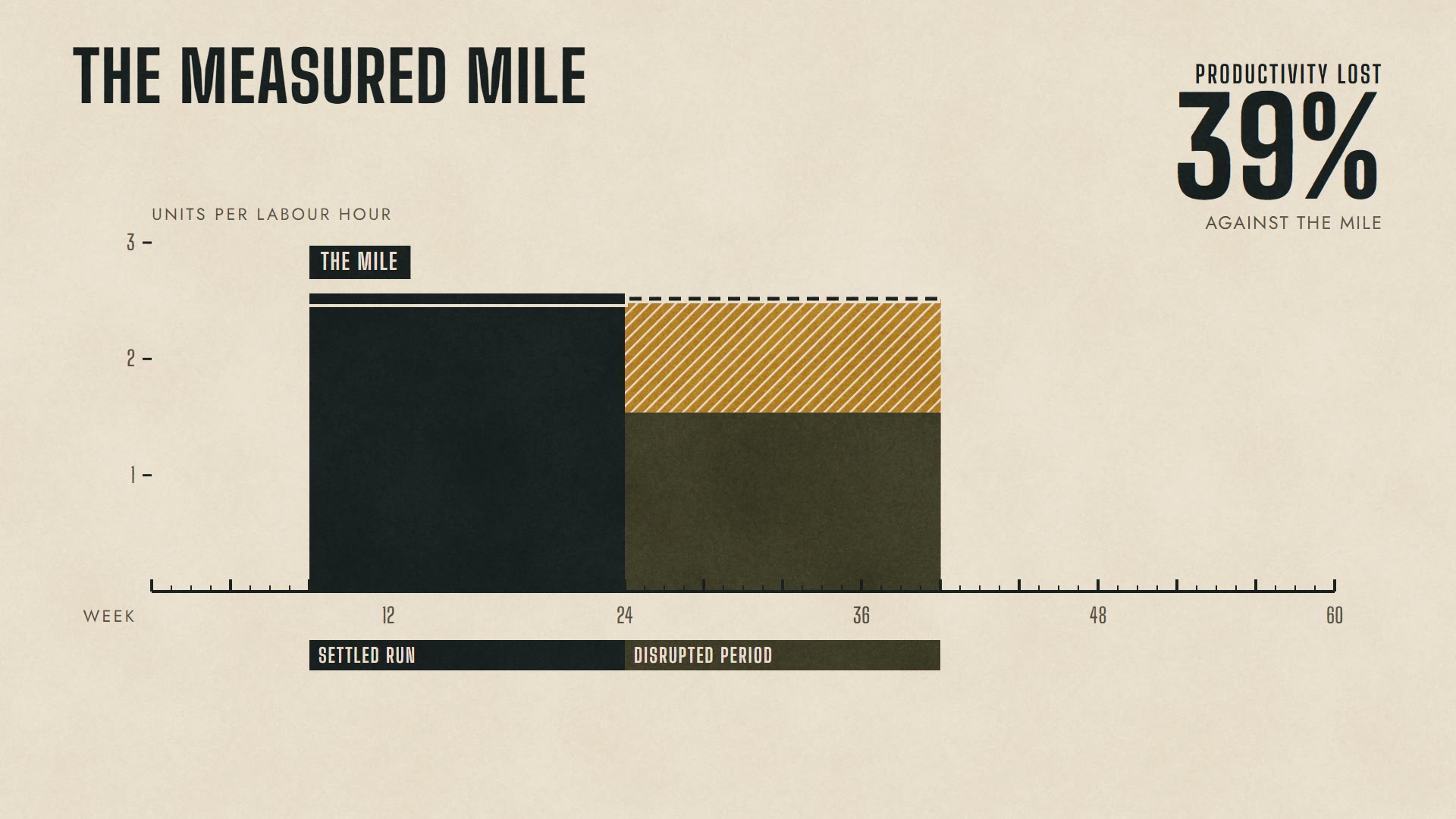
The second method is the measured mile. It compares productivity in the areas or periods hit by the disruption events with productivity on identical or like work in areas or periods the events did not touch (SCL 18.16(a)). The baseline is the contractor's own rate on this job. That is why the Protocol prefers it. Subject to the availability of the necessary records, the measured mile analysis is the most widely accepted method of calculating lost productivity. Because it uses actual effects, it removes arguments about the tender and about the contractor's own performance (SCL 18.16). If the gang was a little slow by nature, it was slow in both periods, and the comparison cancels it out.
AACE ranks the methods the same way: properly performed measured mile studies are preferred to earned value analyses, which in turn beat work sampling and questionnaires. AACE's recommended practice was derived from United States and Canadian decisions (s.C.2), so treat it as North American practice. The measured mile has a price: the Protocol warns that it can be complex and document-intensive (SCL 18.16(a)). It needs labour hours and quantities recorded by activity and area, week by week. Without those records there is no mile (chapter 14).
 Play
PlayEnglish judges rarely use the phrase. It appears in Amey v Cumbria, a 2016 TCC decision of HHJ Stephen Davies on road patching work for the county council. Amey compared the output of its gangs on disrupted patching jobs with the output taken from its schedule of rates: 10.94 tonnes against 14.13. It claimed an inefficiency rate of 19.64% (the judgment does not show how that figure was reached from the tonnages), worth £2,094,076.68 ([18.30]). The council's expert said the planned output should have come from the productivity actually achieved where the disrupting event did not occur: an approach the judgment calls the "measured mile" ([18.33]). The judge did not treat Amey's exercise as flawed in its detail: the questions put to its expert on that did not, in his view, undermine it as a quantification exercise ([18.33]). His ground was the tender. Without convincing proof that the tender output was achievable, he would not have accepted it as a realistic starting point for the comparison ([18.34]). Those remarks were obiter: said in passing, not needed for the decision. The claim had already failed on liability ([18.24]).
Akenhead J decided Cleveland Bridge in the TCC in 2012. A quantum expert there explained that he had not been able to use the measured mile or earned value, these being commonly used to assess disruption loss. That records the expert's evidence. It is not a judicial endorsement of either method.
11.5 Choosing the mile
The mile stands in for the job that would have happened without the events. So it must be like the disrupted work in everything except the events. The Protocol's first rule is to compare like with like (SCL 18.16(a)): the same kind of work, done in similar conditions. The mile does not have to come first. It can come after the disruption, once the events have stopped. The Supreme Court of Queensland heard a strike-out application in Santos v Fluor in 2017. Santos, the employer and plaintiff, pleaded a disrupted period from April 2012 to January 2014 against an undisturbed period from February to September 2014, comparing cost per wellpad, not labour hours ([107]). The court accepted that the measured mile is a widely accepted method of calculating lost productivity, and let the pleading stand. The figures were allegations, not findings, and it is an Australian decision.
The learning curve is the commonest trap. Any gang is slow in the first weeks of a new task and gets quicker as it learns. Nobody caused that. So the Protocol says it is wrong to compare work in the learning curve with work done after it. A 2018 TCC case, Fluor v Zhenhua, shows the curve on a real job, though it was not a measured-mile case. The first sixteen monopiles for an offshore wind farm went in at about 1.7 days each; the judge assumed that figure, which was in dispute. Later ones took 1.5 days or less, presumably because the operators had learned the job ([56]). The judge said that, on that assumption, the learning curve would have reduced one claim (which had been waived), and could not be counted a second time against another ([57]-[58]).
The mile must also be long enough. The Protocol requires a baseline long enough to be a reliable sample of undisturbed work (SCL 18.16(a)). A short run of the best weeks is not a fair baseline. Every gang has good weeks, and AACE notes that optimal productivity is rarely if ever at the maximum production rate. A mile built from the best weeks counts ordinary variation as disruption, and overstates the loss.
Sometimes no part of the job was clean. Then the contractor can use the least disrupted period as its mile, to show the minimum likely loss in the periods of greater disruption (SCL 18.16(a)). That answer is conservative by design, because it cannot capture the loss already inside the mile itself (SCL 18.16(a)). Adjustments can help where the baseline was hit by matters the employer does not answer for. But the Protocol warns that the more that are applied, the more theoretical and unreliable the analysis will become.
Then the other causes come out. Disruption is not simply the difference between what actually happened and what the contractor planned (SCL 18.6). Weather, the contractor's own mismanagement, subcontractor problems and voluntary acceleration can all lower productivity in the disrupted period. AACE says they must be removed from that period to the extent these variables occurred during the least or unimpacted period. The logic is simple. The contractor's own weaknesses cancel out only if they were present in both periods. If they got worse during the disrupted period, the extra loss is the contractor's, and it has to come out.
Two quantum mistakes are common enough to name. One is applying the loss to all the hours on the job instead of the hours in the impacted period (AACE 25R-03 s.C.2). The other is failing to deduct the additional labor hours already paid for in change orders, which pays the same hours twice.
11.6 When there is no clean mile
The further the baseline gets from the job, the less it says about what this gang would have achieved. That is the logic behind the Protocol's order of preference. It lists project-specific studies; project-comparison studies; and industry studies in that order, because reliability and general acceptance decrease down the list.
The measured mile and earned value are not the only project-specific studies. A programme analysis runs earned value through a resource-loaded programme, and the Protocol treats it as a variant of earned value (SCL 18.16(c)). Work or trade sampling means watching crews during the job and recording how much of their time is productive. It depends on observation records made at the time, and if these records are not available, this method is unlikely to be persuasive. It can only be done while the job is running (AACE 25R-03 s.C.3), so start sampling when the disruption starts. System dynamics modelling re-runs a computer simulation of the project without the claim events; the Protocol says it is not as commonly used as the others (SCL 18.16(e)). The Protocol does not rank these methods against each other.
Below them sit comparisons with other jobs, and then industry studies. Another job had different people, conditions and management, so its rate says little about this gang unless the other side can test the figures. A comparison with other projects will not persuade unless the data from those projects is open to scrutiny (SCL 18.17). Industry studies publish percentage losses for types of disruption. The Protocol names those of the Mechanical Contractors Association of America (MCAA), the Chartered Institute of Building and others (SCL 18.19). It says they are liable to be criticised as being theoretical, and should be used with caution. AACE's North American commentary gives the reasons. The source data is not always known, and the studies bear no direct relationship to the project in dispute. Some see them as self-serving, and they were written for pricing future changes, not for measuring past losses (AACE 25R-03 s.C.3).
No reported English judgment rules on these tables. The nearest is Costain v Haswell (TCC, 2009), where the contractor's delay expert assumed that winter work takes 1.33 times as long as summer work ([197]). He accepted that he had done no research into the actual effect of winter on work of that kind ([198]). The deputy judge rejected the factor for want of hard facts and figures to support such a claim related to the facts of this case. That claim was for time, not disruption money, but the instinct is the same: a general factor is no substitute for evidence from the job.
Last come the cost-based methods: actual labour cost less the labour cost planned or paid. They do not measure productivity at all, so everything that went wrong on the job, whoever caused it, ends up in the claim. The Protocol says they are unlikely to be persuasive where there are productivity-based methods that can reasonably be deployed. Even a modified formula that strips out tender errors and the contractor's own events still leaves a global claim (SCL 18.22). A cost comparison can still serve as a cross-check on a productivity method (SCL 18.25).
Contractors sometimes claim cumulative impact: that many events together cost more than the sum of their separate effects. The Protocol says particular care is needed, because of the risks of a global claim. But the approach may be valid, and even persuasive, if all causes of disruption can genuinely be said to be the Employer's responsibility. Their financial effects must also be impossible or impracticable to separate. Chapter 12 deals with global claims.
Whatever the method, the analysis runs backwards from the effect. It starts with a review of productivity over time (SCL 18.7), to see when productivity fell and which work was hit. Then it pins each dip to an event, and takes everything else out. The records decide whether that can be done. In Van Oord v Allseas (TCC, 2015) the daily reports and other documents said little about disruption, and detailed claims came months or years later. Coulson J held that those facts were plainly factors undermining the credibility of the claims. The silence supported other evidence; it did not decide the claims by itself.
Silence counts against a contractor because real disruption is noticed when it happens. In Amey the council's expert pointed out that the claim implied a 50% loss of productivity across the whole contract and the whole county. The judge found the point commercially astute. If Amey had genuinely believed the council was to blame, something would surely have been said or done at the time ([18.34], again obiter).
Thin records do not always mean nothing. In Cleveland Bridge, Severfield-Rowen (SRS) counterclaimed against its steel supplier for disruption to the erection of the Shard's steelwork. SRS's erection subcontractor had used 808.5 man shifts on the steel up to level 9, against 630 planned ([155]). The judge accepted the 630 planned shifts on other evidence. SRS's own quantum expert had no timesheets or daily records detailed enough to identify standing time ([154]). The judge still found that there must have been disruption in the sense of reduced productivity, caused by Cleveland Bridge's breaches. He made a reasoned assessment at the minimum probably attributable: 40 man shifts out of a possible 178.5 ([156]). That is a rescue, not a method, and chapter 12 tells the story. Where the causes are too intermingled to separate, what remains may be the rare case in which a claim can be made as a composite whole (SCL 18.5).
Checklist
- Name the legal route first: variation, loss and expense, compensation event or breach.
- Record labour hours and quantities by activity and area, every week, from the start.
- Record disruption in the daily reports on the day it happens.
- Price the disruption into each variation when it is agreed.
- Choose the mile by rule, not by result: like work, outside the learning curve, long enough, not just the best weeks.
- Take out the contractor's own problems before the other side does.
- If the tender is the baseline, prove the tender was achievable.
- Apply the loss only to the impacted hours, and give credit for hours already paid in variations or prolongation.
Lost hours become money in chapter 13. When the causes cannot be separated, chapter 12 takes over, and chapter 14 covers the records that make a measured mile possible.