Construction, Interrupted

Delay and disruption claims
Peter BrogdenKeating Chambers
Delay and disruption claims
What delayed completion, and for how long?
What is that delay worth, and who bears it?
The tribunal decides. The experts help.
“The claimant is entitled to an additional EOT of 119 days (or 17 weeks), but to prolongation of only 27 days.”
Thomas Barnes [157]
“it must be for the Court to decide as a matter of fact what delayed the Works and for how long”
Walter Lilly [377]
23It moves the completion date for delay at the employer's risk.
Liquidated damages run from the new date, so the contractor pays for fewer weeks.
It gives time, not money.
Only delay to completion counts, and only as much as the event caused.
“The act relied on must actually prevent the contractor from carrying out the works within the contract period or, in other words, must cause some actual delay.”
Adyard [282]
5An employer cannot hold the contractor to a date its own act made impossible.
The employer's own act delays completion
Does a clause give time for it?
“extension of time clauses exist for the protection of both parties to a construction contract or sub-contract.”
Multiplex [49]
6Three boxes: no time and no money; time only; time and money.
“The Relevant Matters overlap with, but are not identical to, the Relevant Events which may give rise to an extension of time”
Clerkenwell [14]
7The delay the event caused to completion, added to the current date.
Fair and reasonable gives room to estimate. It does not license a discount.
If the contractor is already late, its own lateness stays at its own risk.
“The fact that the Architect has to award a "fair and reasonable" extension does not imply that there should be some apportionment in the case of concurrent delays. The test is primarily a causation one.”
Walter Lilly [370]
“Employer Delay to Completion does not exonerate the Contractor for all its delays prior to that Employer Delay to Completion occurring.”
SCL Protocol 10.14 (p.31)
8A notice tells the other side, in writing and in time, that a claim for time or money is coming.
The employer carries the risk. In return it asks to be told while it can still act.
“Contractual terms requiring a contractor to give prompt notice of delay serve a valuable purpose; such notice enables matters to be investigated while they are still current. Furthermore, such notice sometimes gives the employer the opportunity to withdraw instructions when the financial consequences become apparent.”
Multiplex [103]
9It turns on the words used, read in their context.
Something must make the relief conditional on the notice.
Clear words, usually. The label condition precedent is not needed.
"Shall" is usually there, but is not enough on its own.
No fixed number of days is needed.
“Almost any sentence beginning with the word "if" is conditional. A sentence whose structure is "if-then" is the paradigm of conditionality.”
DBS v Tata (CA) [75]
10The person the contract names to decide, while the work goes on, whether the contractor gets more time and money.
| Contract | The certifier is called |
|---|---|
| JCT Standard Building Contract | Architect / Contract Administrator |
| JCT Design and Build 2016 | The Employer decides itself, usually through its Employer's Agent |
| NEC4 | Project Manager |
| FIDIC Red Book 2017 | Engineer |
12Not an independent person. Bound to act in an independent manner.
Its decision binds only until an adjudicator, arbitrator or court reopens it.
“They connote that the decision-maker must use his professional skills and his best endeavours to reach the right decision, as opposed to a decision which favours the interests of the employer.”
Scheldebouw
13Activities, each with a duration, linked in the order they must happen. Together they form a network.
From that network the software works out the dates, the float and the critical path.
The bar chart is the picture. The logic lives in the native file.
15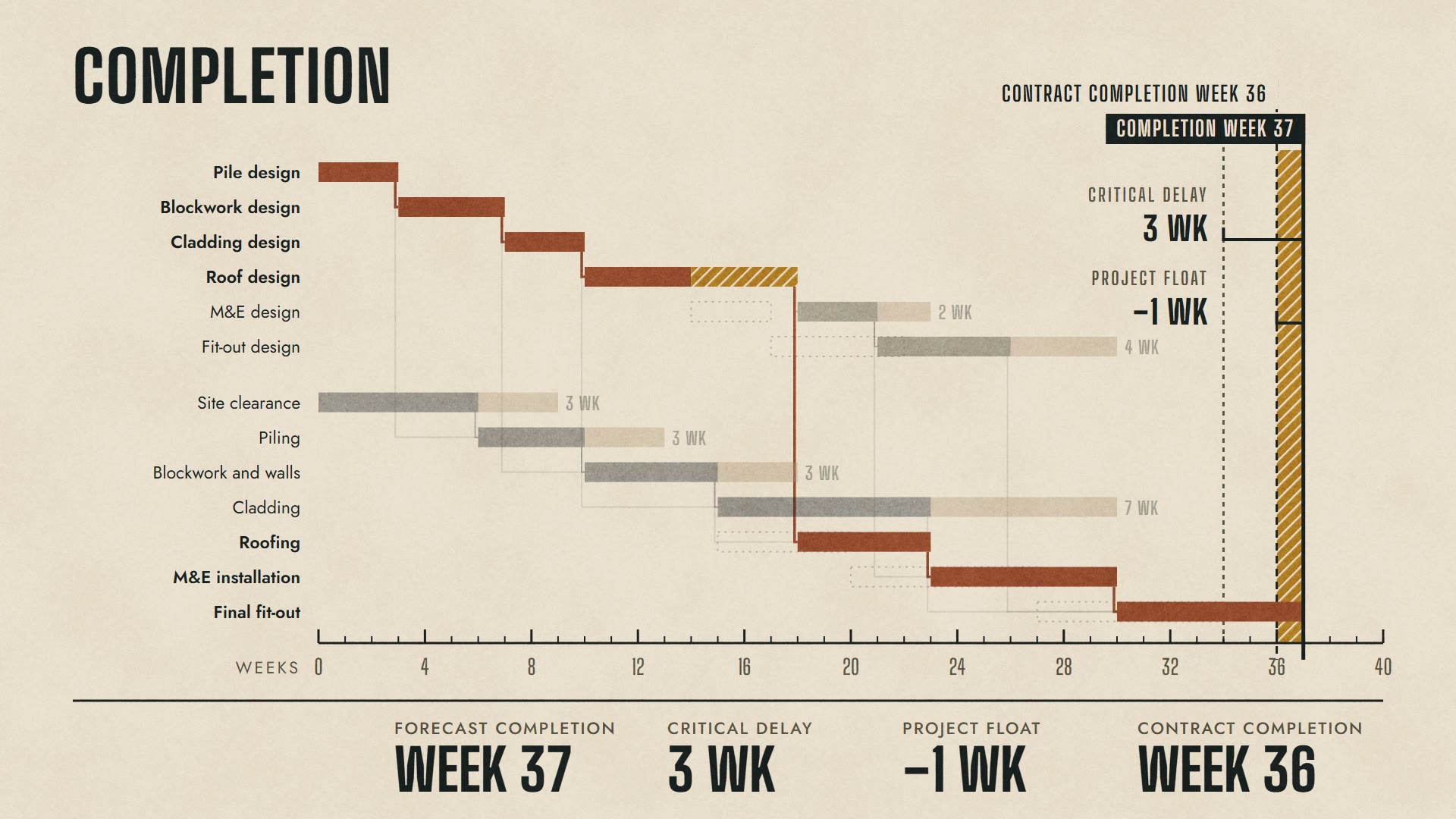
An event that only uses float has caused no delay to completion. It earns no time.
“delays which impact the completion date must, by definition, reside on the critical path”
SCL Protocol 11.4(b) (p.33)
18Float is not property. It is the gap between two dates. Ask which date the extension clause protects.
“completion of the Works or of any Section is likely to be delayed thereby beyond the relevant Completion Date”
Mace v Baltic [44]
“A delay to the Completion Date is assessed as the length of time that, due to the compensation event, planned Completion is later than planned Completion as shown on the Accepted Programme current at the dividing date.”
NEC4 ECC cl 63.5
20The programme says which work controlled the finish. The records say why it ran late.
“Whilst I am prepared to accept this evidence from a theoretical delay analysis viewpoint, comparing the as-planned programme with the position at various points in time, it does not seem to me to be a sufficient answer to the point on causation”
Thomas Barnes [143]
“What one can not do is to identify the last of a number of events which delayed completion and then say it was that last event at the end which caused the overall delay to the Works. One needs to consider what critically delayed the Works as they went along.”
Walter Lilly [365]
21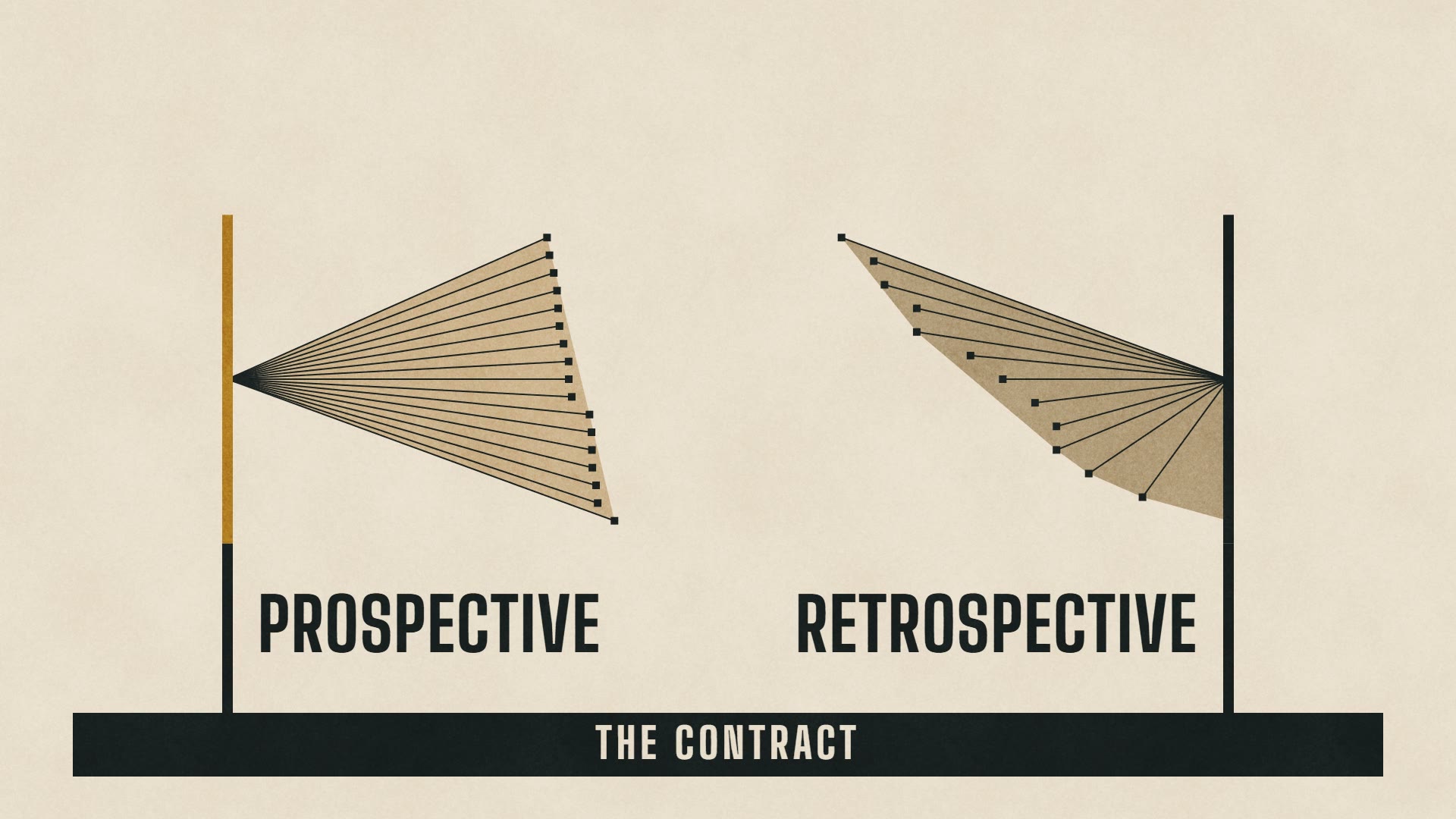
Settle the frame first. The method comes second.
| Decision | Frame | Where |
|---|---|---|
| JCT interim grant | Forecast: likely to be delayed, as he then estimates | JCT DB 2016 cl 2.25.1; Mace v Baltic [45] |
| JCT final review after practical completion | Look back: all the delays have happened | Walter Lilly [125(e)] |
| Court or arbitrator deciding after the event | Look back: what the events actually caused | Walter Lilly [362] |
| Adjudicator reviewing an interim grant | Forecast, as at the notice; later events ignored | Mace v Baltic [50]-[51] |
| NEC4 compensation event | Both, split at the dividing date | NEC4 ECC cl 63.1, 63.5 |
23The party that says the job was delayed proves it. The tribunal decides the facts, and it will not build an unproved case.
“The onus of proof is on OHL to prove that it was delayed by the matters now relied upon by it as critically causing it delay up until the time of termination.”
Obrascon [272]
“TCS has simply not discharged the burden upon them to demonstrate the date by which it would have Achieved the Milestone”
Tata v DBS [222]
24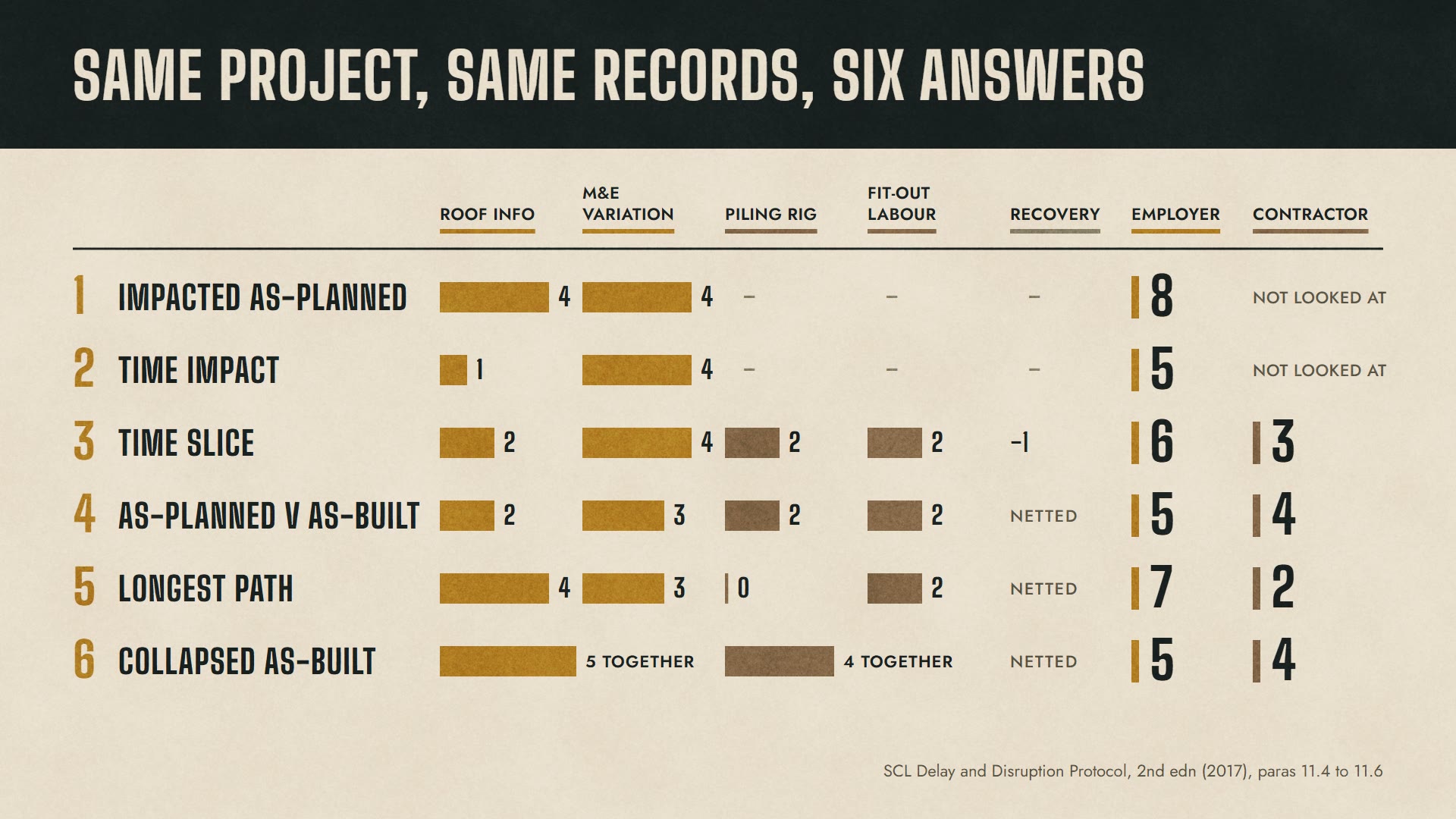
Does the analysis answer the question the contract asks? Was it run against the records?
“it would be wrong to proceed on the basis that, because the SCL Protocol identifies six commonly used methods of delay analysis, an expert is only allowed to choose one such method and any deviation from that stated approach renders their opinion fundamentally unreliable”
Thomas Barnes [110]
“However, I do accept that if an expert selects a method which is manifestly inappropriate for the particular case, or deviates materially from the method which he has said he is following, without providing any, or any proper, explanation, that can be a material consideration in deciding how much weight to place on the opinions expressed by the expert.”
Thomas Barnes [110]
27A record made at the time was written before anyone knew what would matter. Silence counts too.
“Although this cannot be regarded as a rule of law, those documents are generally regarded as far more reliable than the oral evidence of witnesses, still less their demeanour while giving evidence.”
Simetra v Ikon [48]
“the truth is that, in the round, they are of much greater assistance to AUK for what they do not say, than they are to OSR for what they do say.”
Van Oord v Allseas [51]
28A PDF shows the bars. The native file holds the logic, the float, the calendars and every saved version.
“No version of any programme should be overwritten”
SCL Protocol 1.59 (p.21)
29One period of late completion, two causes, one at each party's risk.
Each cause in fact held up completion over the same period.
The but-for test fails both ways, so the law has to choose a rule.
“a period of project overrun which is caused by two or more effective causes of delay which are of approximately equal causative potency”
North Midland [16]
31Time and money answer different questions.
“The general rule in construction and engineering cases is that where there is concurrent delay to completion caused by matters for which both employer and contractor are responsible, the contractor is entitled to an extension of time but he cannot recover in respect of the loss caused by the delay.”
De Beers v Atos [177]
32The rule on time began as common ground in Malmaison.
It rests on first-instance decisions: De Beers [177] and Walter Lilly [370].
No appeal court in England and Wales has decided the point.
“a contractor's entitlement to an extension of time in circumstances of concurrent delay is not entirely free from doubt.”
North Midland [17]
34Who bears concurrent delay is a question of risk, and allocating risk is what contracts do.
“any delay caused by a Relevant Event which is concurrent with another delay for which the Contractor is responsible shall not be taken into account”
North Midland [6]
“That was an allocation of risk which the parties were entitled to agree”
North Midland [39]
35The price buys the works by the completion date. Catching up its own delay is the contractor's cost.
An earlier date than the contract requires: the employer must buy it. Fix the price and the records first.
Reasonable acceleration against the employer's delay is damages, even if it failed. Only the extra cost, and only the part aimed at that delay.
A refused extension is not an order to go faster. English law rarely recognises constructive acceleration. Have the extension decided first.
Disruption is about hours, not dates. Work can be disrupted and still finish on time.
“It is possible for work to be disrupted and yet for the works still to be completed by the contract completion date. In this situation, the Contractor will not have a claim for an EOT, but it may have a claim for the cost of the lost productivity.”
SCL Protocol Guidance Part A, para 7 (p.10)
38Direct causes: piecemeal access, work out of sequence, design change.
Knock-on effects: crowding, stacked trades, split gangs, overtime, learning again.
Change disturbs the unchanged work around it.
Not every slowdown is the employer's: rework, poor planning and an optimistic tender are the contractor's.
39Name the route: variation, loss and expense, compensation event, or damages for breach.
Prove three things: the event, that it caused disruption, and that the disruption caused loss.
Proving disruption does not prove loss.
“Disruption is also not a cause of action at law in its own right.”
SCL Protocol 18.4
40The loss is the gap between the productivity the contractor would realistically have achieved and what it achieved (SCL 18.9).
“Original tender assumptions should not automatically be considered as a 'realistic and achievable' baseline.”
SCL Protocol 18.9
“Of these, and subject to the availability of the necessary records, the measured mile analysis is the most widely accepted method of calculating lost productivity.”
SCL Protocol 18.16
41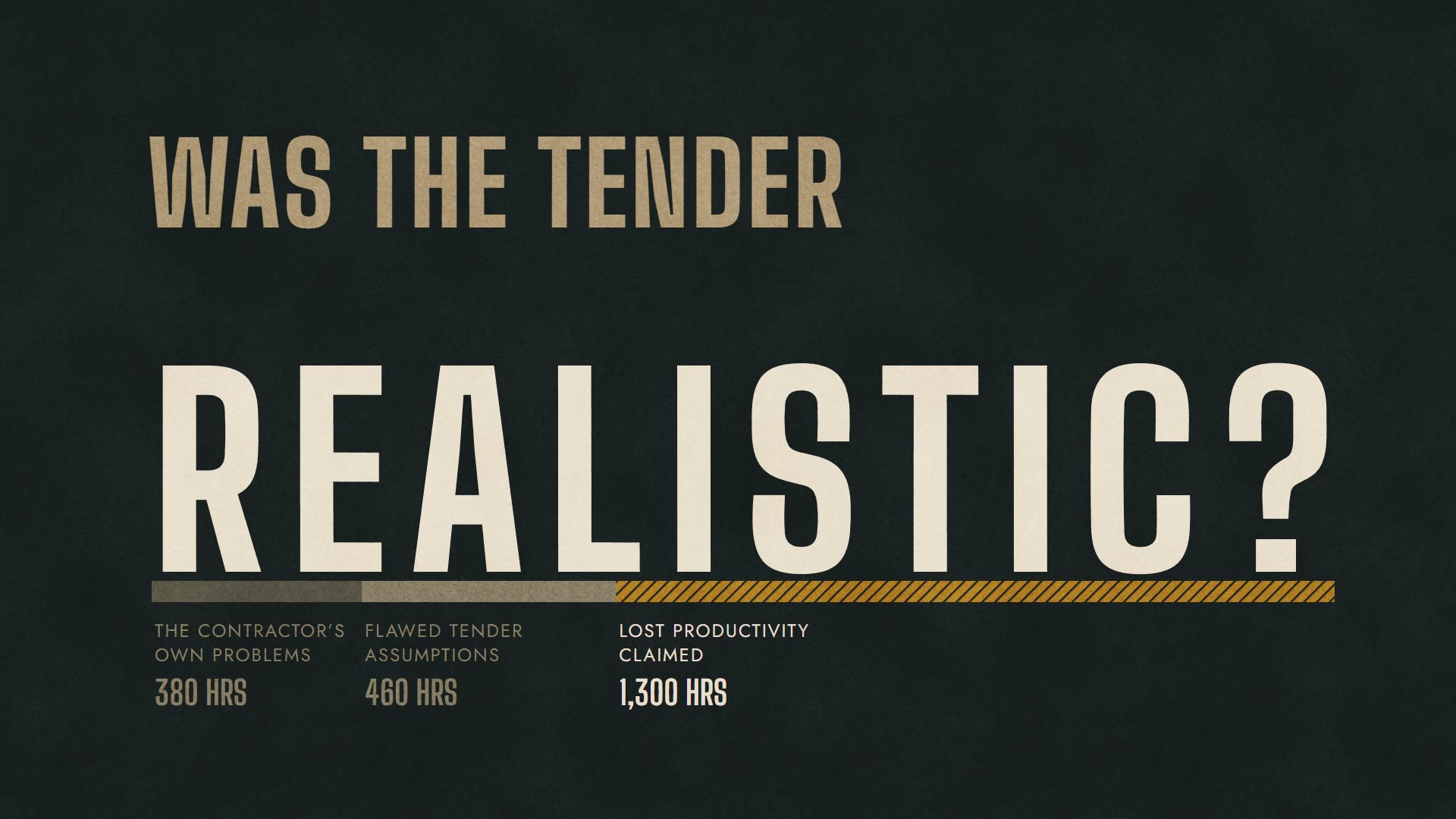
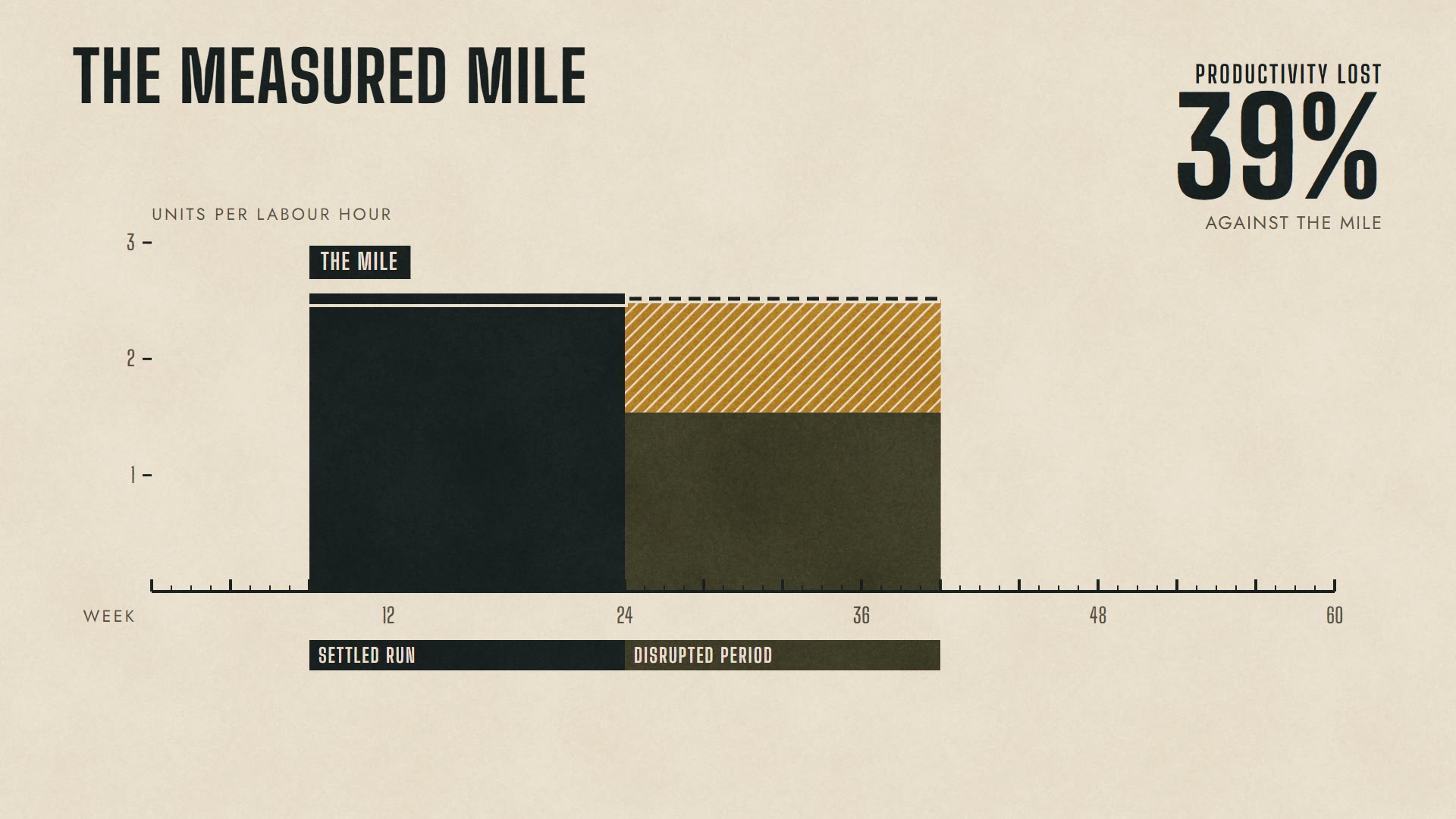
The further the baseline gets from the job, the less it says about this gang (SCL 18.15).
| Method | What it needs | Weight |
|---|---|---|
| Other project-specific studies: programme analysis, trade sampling | Resource-loaded programme; observation records made during the job | Persuasive only with the records |
| Comparison with other projects | Data from those jobs open to scrutiny | Different people, conditions and management |
| Industry studies | A published factor for a type of disruption | Liable to be called theoretical; use with caution |
| Cost-based methods | Actual labour cost less planned | Unlikely to persuade where a productivity method can be used |
45Would the loss have happened without the employer's event? If so, the employer does not pay for it.
Start from the loss and work back to its causes.
Take out every cause that is not the employer's. What is left is what the employer caused.
“the Contractor has to demonstrate on a balance of probabilities that, first, events occurred which entitle it to loss and expense, secondly, that those events caused delay and/or disruption and thirdly that such delay or disruption caused it to incur loss and/or expense”
Walter Lilly 486(a)
46Close correlation, backed by records made at the time, can carry a claim to the balance of probabilities.
Where the records link the event to the extra resource, the costing follows.
“In my view, these contemporaneous documents are a useful starting point when trying to work out what was happening on site at any given time”
Van Oord v Allseas [51]
“That the reports and other contemporaneous documents in this case make so few references to standing time or disruption, and the fact that detailed claims were not made in the large amounts now advanced until months, even years, after the period in question, are plainly factors undermining the credibility of OSR's claims in these proceedings.”
Van Oord v Allseas [54]
47The contractor must show its price would have made a return, and that nothing else caused the loss.
The burden stays with the contractor.
“What is commonly referred to as a global claim is a contractor's claim which identifies numerous potential or actual causes of delay and/or disruption, a total cost on the job, a net payment from the employer and a claim for the balance between costs and payment which is attributed without more and by inference to the causes of delay and disruption relied on.”
Walter Lilly [484]
“There is nothing in principle "wrong" with a "total" or "global" cost claim.”
Walter Lilly 486(d)
48If the other cause can be valued, take it out. What remains is still the employer's.
If it cannot be valued, the inference from the gap fails, and the claim may fail with it.
“The fact that one or a series of events or factors (unpleaded or which are the risk or fault of the claimant contractor) caused or contributed (or cannot be proved not to have caused or contributed) to the total or global loss does not necessarily mean that the claimant contractor can recover nothing.”
Walter Lilly 486(e)
“The Contractor must be aware that there is a risk that a global claim will fail entirely if any material part of the global loss can be shown to have been caused by a factor or factors for which the Employer bears no responsibility and it is not possible for the CA, adjudicator, judge or arbitrator to assess the value of that non-recoverable portion on the available evidence.”
SCL Protocol 17.5 (p.43)
49The Shard steelwork. Cleveland Bridge [152]-[160].
“What the Court can and should do in circumstances where it is satisfied on a balance of probabilities that some (more than de minimis) disruption must have occurred as a result of CBUK's breaches is to make a reasoned assessment albeit based on the minimum probably so attributable.”
Cleveland Bridge [156]
“The broad axe assists the court in quantifying a proved loss; it does not relieve the Claimant of proving that a legally recoverable loss was suffered.”
Lumley Baxter v Aviva 124(v)
50An extension of time moves the date. It does not carry money.
Money needs its own basis: a clause of the contract, or damages for breach.
On either route: an employer event, a loss, and the link between them.
52Only delay to completion keeps the site open longer. Float carries no cost.
The measure is the actual extra cost. The tender allowance is not a cap.
Price the weeks when the delay bit, at what the site cost then.
“Once it is established that compensation for prolongation is due, the evaluation of the sum due is made by reference to the period when the effect of the Employer Risk Event was felt, not by reference to the extended period at the end of the contract.”
SCL Protocol Core Principle 22
54Every job pays something towards running the business.
57Head office would have been paid anyway. The loss is the contribution the next job would have made.
Prove that work was there to be won. Then a formula may measure the return.
“It is necessary for the contractor to prove on a balance of probabilities that if the delay had not occurred it would have secured work or projects which would have produced a return (over and above costs) representing a profit and/or a contribution to head office overheads.”
Walter Lilly 543(b)
58All three measure what the job would have put towards head office and profit during the delay.
A week's worth of the contract's overheads-and-profit share, times the weeks of delay.
This job's share of the real head office cost, per day, times the days of delay. Overheads only, no profit.
59The parties fix the price of late completion in advance: no loss to prove, a known exposure.
It is the only damages for the delay it covers, in either direction.
A court enforces it unless it is out of all proportion to the employer's interest.
“In a negotiated contract between properly advised parties of comparable bargaining power, the strong initial presumption must be that the parties themselves are the best judges of what is legitimate in a provision dealing with the consequences of breach.”
Cavendish v Makdessi [35]
61From the completion date, as extended, to practical completion or take-over.
An extension moves the start, so the contractor pays only for delay it caused.
JCT: the notices in order, then a Pay Less Notice before deducting.
If the date moves later, the employer repays.
62Termination ends future obligations, not rights already earned. Accrued liquidated damages stand.
After it the contractor no longer controls the time to finish. The employer proves its loss.
Time at large is the same: no date, no liquidated damages, ordinary damages instead.
“I conclude that it is ordinarily to be expected that, unless the clause clearly provides otherwise, a liquidated damages clause will apply to any period of delay in completing the work up to, but not beyond, the date of termination of the contract.”
Triple Point [86]
63The expert calculates. The tribunal decides what delayed the works.
The claimant proves its delay. The tribunal need not repair its analysis.
The expert is paid by one side but owes the duty to the court.
Agree the method early, and exchange the native programme files.
“it must be for the Court to decide as a matter of fact what delayed the Works and for how long”
Walter Lilly [377]
“It is the duty of experts to help the court on matters within their expertise.”
CPR Part 35 r.35.3(1)
65Adjudication is for cash flow: a decision in 28 days, binding for now.
Enforced unless he answered the wrong question or was obviously unfair.
He may use his own analysis, but he must tell the parties first.
Test the expert's inputs, his assumptions, and what the site noticed.
“The need to have the "right" answer has been subordinated to the need to have an answer quickly.”
Carillion v Devonport [86]
“he may not of his own volition use them to make good fundamental deficiencies in the material presented by one party”
Balfour Beatty v Lambeth [33]
66Ask the two questions in order: what delayed completion and for how long, then what that delay is worth and who bears it.
Time and money are separate entitlements, and an extension of time does not by itself bring money.
Serve every notice as if the clause were a condition precedent.
Only delay on the critical path moves completion, and the path can move as the job goes on.
The programme shows what was critical, and the records made at the time show what caused it.
67The law prescribes no method of delay analysis, and weight turns on whether the method fits and whether the expert explains it.
Concurrent delay gives the contractor time but not money, unless the contract says otherwise.
Disruption is lost productivity, measured where the records allow against the job's own undisrupted work.
The Protocol says prolongation is paid at the cost actually incurred, in the period when the delay was felt, unless the contract says otherwise.
The tribunal decides and the experts help it, so agree the method early and serve the native files.
68Sixteen chapters, here to stay
delay.brogden.io